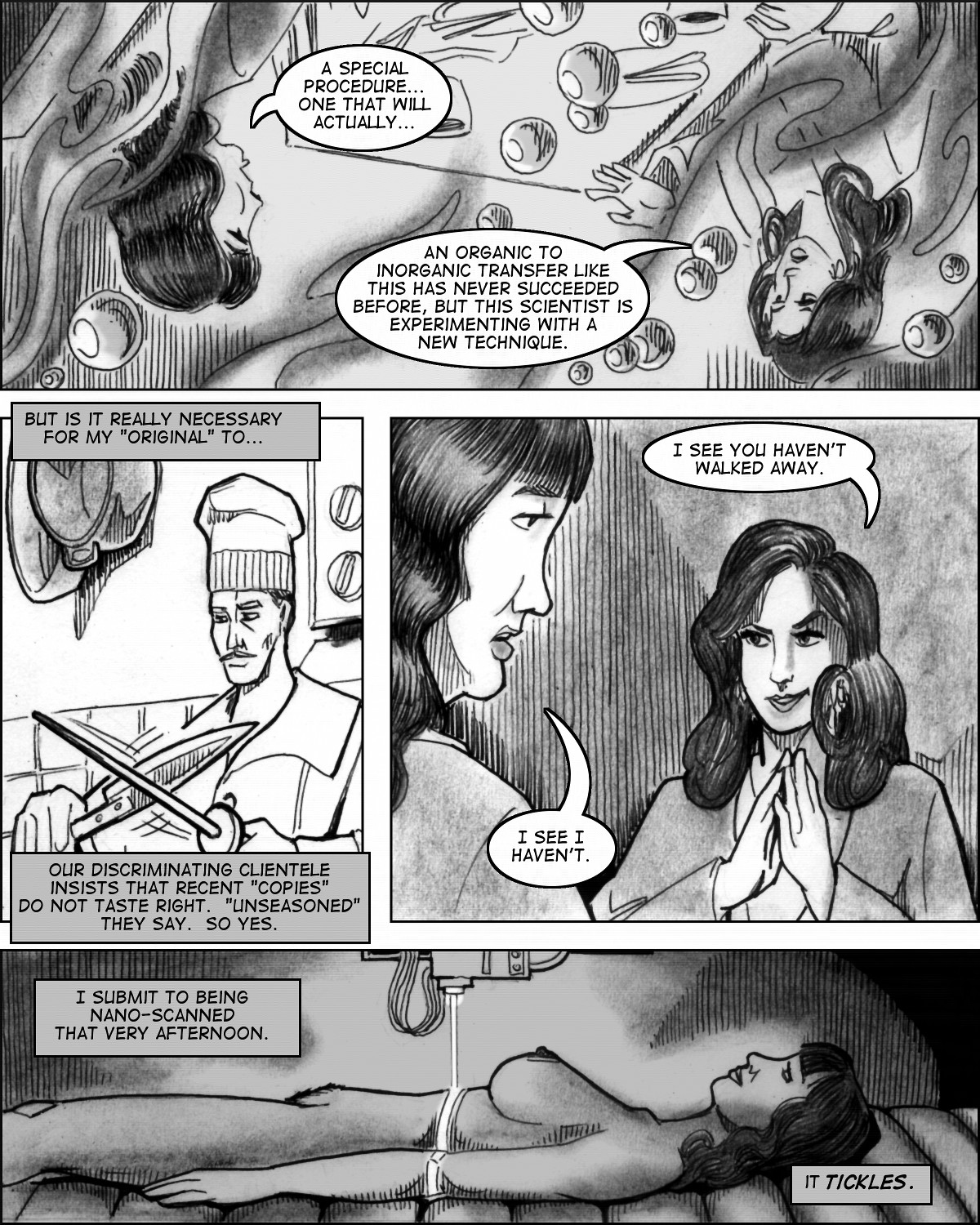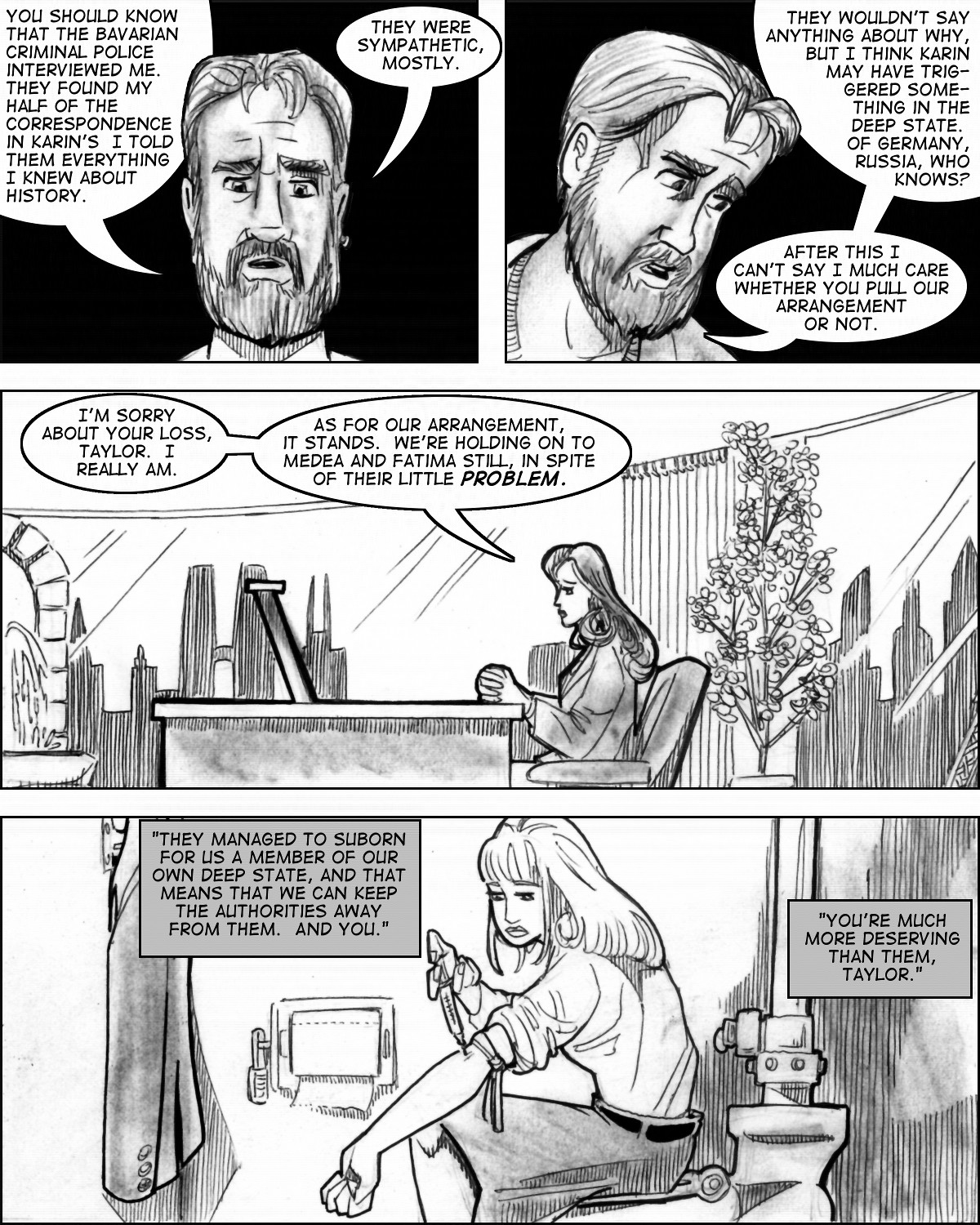
One way to cause thug fail
Readers of the EroticMadScience blog in its early days might recall a post on the real-world models for the four studiers-abroad in which I commented that Iris Brockman was a bit more buxom than her model Hedy Lamarr and insisted further that this really was a plot-relevant detail.
See? It was. Iris was able to play on the fact that there are certain things for which men (straight ones, anyway) are fools in order to effect the rescue of Cleo.
Well, maybe that all still seems adolescent. Rather than resist I’ll just play along by throwing in a fake motivational poster that is (I hope) on point.
Found here at Motifake.com.
A different perspective
I must say I’m still not sure what dark crevice of my mind this bit of dialog in Where Am I? came out of:
TAKAYAMA
Don’t you feel, what is the word? “guilt” at having in effect murdered one of your professors?
iris
Thanks to you and your associates, Mr. Takayama, I have already been dead any number of times. It changes one’s perspective.
TAKAYAMA
Ah, an excellent answer, Miss Brockman.
Or even further and odder the moment where Iris gazes on the petrification device provided by Takayama’s mysterious and somewhat sinister organization and contemplates something awful — to most people.
Iris picks up the camera-petrifying device, which is sitting on her desk, and looks into its business end.
IRIS
(to herself)
It has its appeal, doesn’t it?
But it must be said that even these strange and disturbing thoughts have some sort of science-fiction antecedent.
(My source for this image is the blog Posthuman Blues.) If that isn’t as mad-science as it gets, I’ll eat my rheostat. I don’t know much about the story, although the Wikipedia entry on author Paul W. Fairman indicates that the story “The Girl who Loved Death” was published in 1952. Casual nosing around hasn’t yet turned up a copy of the text of the story (did nobody ever love it? — the closest thing to a review I was able to find wasn’t terribly positive) but the cover itself surely speaks volumes.
The 1950s were supposedly a bland and conformist decade, the time of Leave it to Beaver and Ozzie and Harriet, but looking more carefully one finds some very strange stuff back there.
Suborn and petrify
The means through which Iris dispatches Professor Mora once and for all draw on a certain curious A.S.F.R. micro-genre which, for want of a more obvious name, I’ll call the “suborn and petrify panel.”
To make something in the micro-genre, someone takes a picture of a pleasing model (usually female, usually naked or near-to-it) and modifies the image of the main figure (I assume using image software) to make it look like the model’s flesh has turned or is in the process of turning to stone, gold, or some other hard inanimate substance. One then attaches a micro-narrative to the image, which explains how the figure was gotten out of her clothes in the first place (a pretext, like a modeling assignment or an assignation or just something as simple as taking a shower) and then turned into a statue by some magical or technological means. Needless to say, this transformation comes as a surprise (probably a rather shocking and unpleasant surprise) to the character depicted. It’s an intended petrificaton, unlike that which happened to Ashley Madder back in the Apsinthion Protocol, which was an accident. Sort of.
A large source of these panels can be found at the Medsua Realm here. One example, from the artist calling verself Eocene, is this.
Kinda twisted, yes? (Yes! Yes!) I don’t want to speculate too much about the psychology that drives the creation of images and micro-narratives of this kind. I do know what drives Iris and her elaborate set-up that leads to doing the same to Professor Mora. Iris is really mad, and it’s not enough just to dispose of the problem professor. She wants to humiliate an enemy in the process.
What a process, at that! Another image from the artist calling verself Rodin.
And Iris’s revenge runs deep, not just because it’s humiliating to find yourself naked when you really shouldn’t be, but because Iris has created a living metaphor: the process of exposing Professor Mora’s body is at the same time the process of exposing Mora as intellectually fraudulent. Well done, Iris!
That last is an entry in the micro-genre from the artist calling verself “Drake,” who I think went on to more ambitious projects over at Medusarrific.
Bathhouse dreams
Having struck out utterly with Michiko Maeda in real life, Buck re-encounters her in that natural realm for Michiko, that of dreams.
And since he’s a lousy human being, Buck naturally turns to the same conceit that didn’t work so well for John Samson, to with that of Asia consisting of easily dominated countries the distaff side of whose populations consists of submissive, available objects of sexual solace. Perhaps Buck has been reading some overly popular history, because his erotic vision takes on an explicitly militarized form.
And where does he get the idea that his fantasy should be situated in a bathhouse? Well, that’s probably a natural possible place into which to inject a sexual fantasy. Hokusai Katsushika, the same artistic genius who gave us the ur-illustration of tentacle sex, also created at least one shunga illustration of bathhouse sex. Via AK-Antiek:
And maybe Buck has been looking at art like that for inspiration. Though frankly I think it’s more likely that he’s been watching certain work of Yua Aida…
Thank you Alice Japan! Though it doesn’t do poor Buck much good, because Iris has kidnapped the part he needs to masturbate with…
Higher superstition
Sometimes the running sores of prior life experience don’t quite heal altogether and thus show up in things we write years or even decades later.
Adherents of the academic movement known as postmodernism, at least with respect to the the poseur attitudes they struck toward science and technology, were the viri that made me break out in such sores for years. Condescending, glib, smug…and for the most part shockingly ignorant of the substance of what they aimed to criticize. they blighted my academic years and left me with the enduring sense that the academic enterprise was at least in part fraudulent. So it was perhaps inevitable that I would create a character like Aphrodite Mora and the seminar she runs at Gnosis.
I wish I could point to something erotic about this particular scene, but sadly I find willfully cultivated obscurity something of a turn off. But I can at least point to a source text for the scene, which is to wit the excellent and witty book shown to the left, especially pp. 54-5 thereof. Enjoy!
In the sculpture court
So I went image-delving to try to give the reader a bit of visual experience to go along with the narrative of Iris in the sculpture court where she discovers the statue made out of Ashley Madder. This naturally involved a trip to the Medsua Realm, a great big A.S.F.R.-related site where they do that sort of thing well.
My eye was first attracted to the image at the left, presented on one of their webfinds pages. Not much provenance there, unfortunately. But we do live in a happy Internet era, and there is now a tool called TinEye, which is a reverse image search. Got an image you’re wondering about? Well, now you either upload it or just send the URL to TinEye and it will give it a shot for you. On this image, I was able to turn up that this is a sculpture known as “Femme Eternelle.” Neat! (Unsurprisingly, TinEye is now listed on my links bar as one of the Cool Tools, so by all means enjoy it.)
Interesting. Over to Google image search. Can I find it larger or better or more like it? Enter “femme eternelle sculpture” and all sorts of interesting results come back. Nothing bigger on this one, but something did come up that seemed even better from the perspective of “sculpture court visual experience.” It’s a woman on a pedestal, indentified only by the title “Une photo d’art.”
That from a French-language blog called The Dreamsland, whose collection of photography is so exquisite that it too is now added to the EroticMadScience blogroll.
Looking good enough to eat
I realize of course that there is no small squick involved in core scene about the adventures of Iris in the Club Cuisine, but that, too, was a scene that boiled up out of some corner of my mind that I saw myself as having no right to ignore. And I realize that the squick seems likely to continue to pertain, even though Iris comes through hale and sound (or does she?).
That all this should have boiled up is perhaps no accident as well: cannibalism has a long history of being both a marker of transgression and punishment. In the long cycle of misdeeds the culminates in the Oresteia, Atreus kills and cooks the sons of Thyestes. Who can forget the ghastly feast of Ugolino in Canto XXXII of Dante’s Inferno? Or a certain notorious scene in Shakespeare’s, Titus Andronicus?
Where there is horror, someone is bound to exploit for purposes of eros. It is no accident, surely, that one of the most successful movies of the last few decades features a cannibal who is no primitive, but a scholar so polished and formidable that he cannot but be magnetic, indeed, sexy.
How often have we described someone who looks sexually desirable as “yummy” or “delicious?” And how often have we really thought about the metaphor that underlies what we have said? Do perhaps our guts not move within as our eyes move without?
The phenomenon of cannibalism as kink goes back far. A little recent digging on my part turned up a sonnet, attributed to François de Malherbe (1555 – 1628), discussed in a academic paper here. I won’t attempt a full translation, since my attempts even at nineteenth-century French prose turn out to be a bit too disappointing to merit my trying my hand at sixteeenth-century French verse, but I’ll give the gist. The poet invites a woman, in the midst of the meal, to undress and become “dessert,” perhaps not in an entirely figurative sense. (His compannion is, needless to say, somewhat shocked.)
Là, là! Pour le dessert, troussez-moy cette cotte,
Viste, chemise et tout, qu’il n’y demeure rien
Qui me puisse empescher de recoignoistre bien
Du plus haut de nombril jusqu’au bas de la motte.
Là, sans vous renfroigner, venez que je vous frotte,
Et me laissez à part tout ce grave maintien
Suis-je pas vostre cœur? estes vous pas le mien?
C’est bien avecque moy qu’il faut faire la sotte!
–Mon cœur, il est bien vray, mais vous en faites trop:
Remettez vous au pas et quitte ce galop.
–Ma belle, baissez moy, c’est à vous de vous taire.
–Ma foy, cela vous gaste au milieu de repas…
–Belle, vous dites vray, mais se pourroit-il faire
De voir un si beau C[on] et ne le [fou]tre pas?
No wonder certain things brew up from deep in the dark parts of my mind.
Personal identity porn
As an ardent thaumatophile, I cannot but love the idea of a person scanner, and so does Iris, apparently.
The idea of a scanner that can take your information for re-creation of you later on somewhere else out of new matter is one that has played an important role in thinking about the metaphysics of personal identity. The beginning of Chapter 10 (“What We Believe Ourselves to Be”) of Derek Parfit’s Reasons and Persons contains a famous example.
I enter the Teletransporter. I have been to Mars before, but only by the old method, a space-ship journey taking several weeks. The machine will send me at the speed of light. I merely have to press the green button. Like others, I am nervous. Will it work? I remind myself what I have been told to expect. When I press the button, I shall lose consciousness, and then wake up at what seems like a moment later. In fact I shall have been unconscious for about an hour. The Scanner here on earth will destroy my brain and body, while recording the exact states of all my cells. It will the transmit this information by radio. Traveling at the speed of light, the message will take three minutes to reach the Replicator on Mars. This will create, out of new matter, a brain and body exactly like mine. It will be in this new body that I shall wake up.
Happily this process works, and Parfit’s narrator goes through it many times, until one day…
Several years pass, and I am often Teletransported. I am now back in the cubicle, ready for another trip to Mars. But this time, when I press the green button, I do not lose consciousness. There is a whirring sound, then silence. I leave the cubicle, and say to the attendant, “It’ not working, what did I do wrong?”
“It’s working,” he replies, handing me a printed card. This reads, “The New Scanner records your blueprint without destroying your brain and body. We hope that you will welcome the opportunities this new technical advance offers.”
The attendant tells me that I am one of the first people to use the New Scanner. He adds that, if I stay for an hour, I can use the Intercom to talk to and see myself on Mars.
“Wait a minute,” I reply. “If’ I’m here I can’t also be on Mars.”
Someone politely coughs, a white-coated man who asks to speak to me in private. We go to his office, where he tells me to sit down, and pauses. Then he says “I’m afraid we’re having problems with the New Scanner. It records your blueprint just as accurately, as you will see when you talk to yourself on Mars. But it seems to be damaging the cardiac systems when it scans. Judging from the results so far, though you will be quite healthy on Mars, here on earth you must expect cardiac failure within the next few days.”
The attendant later calls me to the Intercom. On the screen I see myself just as I do in the mirror every morning. But there are two differences. On the screen I am not left-right reversed. And, while I stand here speechless, I can see and hear myself, in the studio on Mars, starting to speak.
Get all that? Ponder it in your head for a moment while you savor another EroticMadScience picture of a scanner at work (though this one is real, not fictional, as you’ll see if you click through on the link).
The point of Parfit’s example is to sharpen (and challenge) our intuitions about what it means to be ourselves and survive as ourselves. There are many different possibilities, the most salient of which are physical continuity and psychological continuity. Since normally your consciousness and your body don’t separate, we don’t experience challenges of this kind in reality.
But Iris is smart. She knows that the two might be separated. Being forced to decide between the two possible theories is at the core of her disagreement with Professor Gregg in the prologue to Study Abroad. Gregg subscribes to a physical continuity theory of personhood, which is why he thinks that the permanently-vegetative “Tabitha Sibling” (fictitious, but arguably based on a real case) has the same moral status as “you or me.” Iris advances contrary to this the psychological continuity theory of personhood.
There is a problem, of course, which is that if we take a hard line on psychological continuity we might end up with a rather big bullet to swallow, to wit, that if we are in the position of Parfit’s narrator, we shouldn’t at all regret the fact that we are about to die of heart failure in a few days, because the guy on Mars is us, psychologically continuous with us, will have conscious experiences like ours, will carry on our projects, love our spouse, rear our children and so on just like we would have done.
Head spinning yet? Oh, but I’m not letting you off quite that easily. The same issues are entertainingly discussed further in a brillian short film by John Weldon, called “To Be.” Watch at any time: unusually for something here at Erotic Mad Science, it’s completely SFW. As to whether it’s safe for your peace of mind, I make no warranties.
The awesome thing about Iris is that, unlike most philosophers, she is willing to put everything on the line, her very existence as a test of the theory she espouses. She (with a little boost with tolmemazine, perhaps? — that in itself poses an interesting philosophical problem) shows herself to be an absolutely fearless bullet-biter. This is experimental philosophy à l’outrance.
Just speculating here, but I’d bet that if in the real-world philosophers were half that courageous, philosophy would command much more respect.
ADDED 11 p.m. The woman in the scanner shot is apparently a hoax that appeared on both Gizmodo and Drudge Report so my “real” claim turns out to be wrong. But I at lesat hope the entertainment value remains, and, I think, the larger philosophical point raised by the post is unimpaired.
A most unusual restaurant
As is so often the case, I’ve discovered that reality is pretty good at outrunning my imagination.
The “most unusual” restaurant in which Iris finds gainful employment was, as best I can recall, derived as a sort of X-rated version of the Weeki Watchee Mermaids, a phenomenon which I learned about by reading Jane and Michael Stern’s engrossing and entertaining Encyclopedia of Bad Taste (a book which you just had to know Dr. Faustus would own). At the time I was writing the scene, I congratulated myself on coming up with a very cool concept, thinking “I bet decadenet rich men would pay a lot to go to a bar with naked girls swimming around behind glass, no?”
And then, as it happened, I was perusing another book in my extensive library by Joan Sinclair entitled Pink Box: Inside Japan’s Sex Clubs (a book you know that Dr. Faustus could surely not resist) and discovered…that there apparently there really are such things are mermaid bars. The caption in the actual book to the thumbnail image on the left reads: “Mermaid hostess bar Fusion, Tokyo. Businessmen pay a ¥40,000 entrance fee to drink and watch foreign women swim in a tank at this exclusive hostess bar.” (Click on the thumbnail to see a slightly larger image and many more as part of a flash presentation at the book’s website.)
Sometimes I wonder how a hard-working pornographer is supposed to make a living. But at least Sinclair’s book doesn’t suggest that the mermaid bar serves…well, seafood.