At least twice in my life I’ve had the experience of being overwhelmed by arousal at a fantasy that simply brewed up while on a long walk when my mind had a chance to wander. An early version of the Apsinthion Protocol was one of these; it happened to me as a graduate student walking back from the university library very late (they had kicked me out at closing time, 1 a.m. as I recall). Maybe it was just fatigue or weary confusion from too many hours spent among obscure tomes, but I found myself jogging along through the lonely dark wondering if I would make it home without…well, you know.
(The first time I attempted to write down something like the Apsinthion Protocol happened as a way of distracting myself during a really boring academic colloquium I attended sometime later. I was sitting at the back of the room. Given the extent to which so many academic colloquia resemble collective wanking sessions, perhaps my behavior was less inappropriate than it might otherwise seem.)
Something like Strangeways’s obscene technology, building on the conceit that female orgasm is such a powerful force that properly channeled it can rend the fabric of reality and result in spontaneous teleportation, was also something that inconveniently occurred to me on a long walk, this on a hot summer day, this in search of a video rental outlet that I had heard had a more interesting sci-fi collection than the ones in town. The fantasy that happened then was of subjects who voluntarily did this — there is something about that leap into the unknown that I find astonishingly compelling as fantasy. The conceit (one that Vinnie Tesla has also explored) lies at the base of both Strangeways’s technology and also the very strange ritual that Maureen will eventually learn about.
Promised you I was strange, didn’t I?
(And the trip to that video store? Paid off. I was able to rent a VHS copy of Galaxy of Terror, a cult-fave that’s pretty hard to find.)
That Strangeways’s elaborate, will-subverting sex machine involves the temporary growing of a golden “second skin” on its occupants is a fantasy that has a pretty obvious origin, one that I and probably millions of others encountered on television as an adolescent.
Yep, Goldfinger (1964). Probably no one could have gotten away with showing that much of Shirley Eaton in a mainstream movie (or in 1970s-80s television) had she not been wearing all that gold paint. But as it was, they could, and she because the stuff that erotic dreams would be made of, for decades.
And perhaps even today. There’s at least one guy out there who’s seems to have been far more influenced by this scene than I. (Possibly Drake at Medusariffic was also more swayed by it, although Drake’s A.S.F.R. thing involves the whole woman turning to gold, rather than just being coated with it.) This is a German artist who’s taken for himself the name of Goldfinger and made an entire fetish of the gold body paint thing, with spectacular results. Like this…
And this…
And (oh my) this…
I was directed to Goldfinger’s fetish work by this post by Michael Blowhard, which links to all sorts of other good stuff, including the only example known to me oferotic Russian-language hip hop that uses an accordian. [Update on May 6, 2018: The old link appears to be long-since broken, but you can find the video in the Internet Archive. You can find the Russian-language lyrics here and the English-language lyrics (with some mistakes that don’t account for the fact that some of Nastya’s exclamations are in Italian) here.] Really.
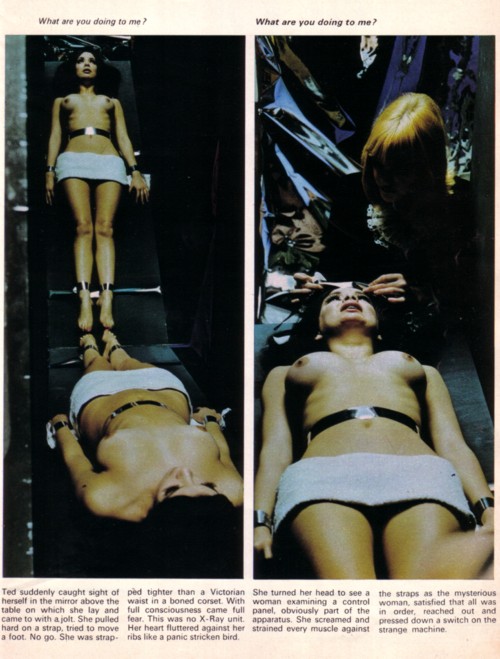
Sometimes catching little snippets of a sci-fi story is highly evocative, perhaps even more so that the story itself. I had something of that experience a few months back when Bacchus at ErosBlog sent me a link to this posting of an oddity over at the online fanzineShowcase.
The point of the posting is to show us something form an old British magazine called Zeta, published in 1968.
This issue was devoted to a weird science fiction story. It was hard to make much sense of the story from the post (probably because the story didn’t make a huge amount of sense to begin with) but there were some intriguing text-image combinations, including one of a woman in a machine:
“What are you doing to me?” Now, I think that the story here is actually that this woman is being abducted as part of a weird all-woman Mars Needs Women-type scenario. But the curious thing is, I think I find the text-image combination here more erotic if I don’t have, or can put out of my mind the original “genuine” context, because it is at that point that one’s imagination can go to work and start filling in the story that I like.
And I hope that perhaps it can also be the basis for beginning to fill in the story you like.
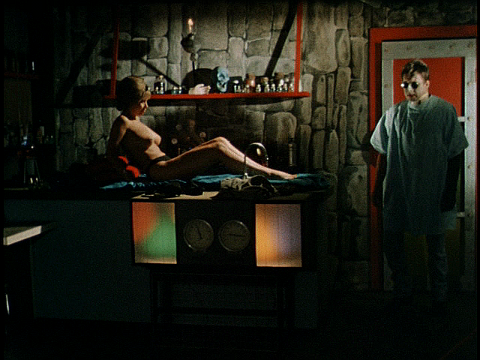
Continuing for a moment the subject of movies in erotic mad science that don’t really do enough with the concept, I should at least note the existence of (and share a few pictures from, naturally) the 1964 nudie-cutieKiss Me Quick!, one of the first productions of sexploitation king Harry Novak.
A mad scientist named Dr. Breedlove is conducting experiments on young women in his castle. The purpose of the experiments is unclear, but has something to do with “perfecting” the young women, who don’t seem to be in much need of perfecting if you ask me, but maybe I’m just not insane enough. In any event, a very dim alien named Sterilox teleports into Breedlove’s mad-lab with the aim of bringing back with him a “perfect specimen,” for purposes of…manual labor on his homeworld (told you he was dim). Mostly the movie is, like most nudie-cuties, an excuse for its comely female cast members to wiggle around fetchingly wearing as little as the law and custom of the time would allow.
Still, there is some appeal to the mad-science setting does carry some appeal. Breedlove has built as sex machine (of course) of which his assistant Kissme is rather fond. Here, Breedlove admonishes her never to use the sex machine when he is not around: “You’re going to sex yourself out of the world, one of these days.”
Personally I think this might have been a much more interesting movie had Kissme gone ahead and done exactly that, but I wasn’t around in 1964 to be asked about it.
Aside from pretty girls and lab equipment, there are always Breedlove’s lunatic pronouncements to help carry us through the movie. A personal favorite: “Don’t be alarmed girls. I had you forcefully [sic] abducted and brought here to my castle for your own good. You’ll see. Just just continue to do as I’ll say, and I’ll make you like you always dreamed you would be made.”
Really.
So not a complete waste of time for the thaumatophile. There’s even now a DVD from Something Weird Video in which you can hear commentary from Harry Novak himself.
Time for another little breather while I get to work putting together Invisible Girl, Heroine for publication to the wider world. In the meantime, for your enjoyment…
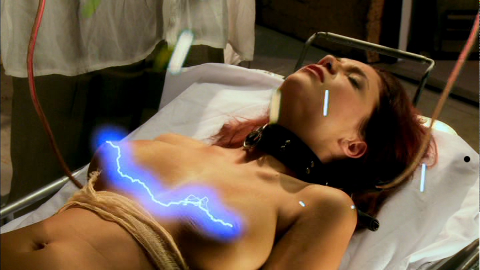
I suggested a little while back that Fred Olen Ray might have something to offer us thaumatophiles in the form of a new movie called Bikini Frankenstein. I plunked down the cash and I had high hopes, but on the whole, meh… Not that there isn’t lots of well-filmed and enthusiastically-acted softcore sex involving very pretty people. Fine if you like that sort of thing, but I couldn’t help somehow feeling like the whole mad-scientist angle was underdeveloped.
Save for one scene, though, in which Dr. Frankenstein brings his creature, played by Jayden Cole to life, which involves some nice…electrical effects.
And you know how us would-be mad scientist types really like electrical effects!
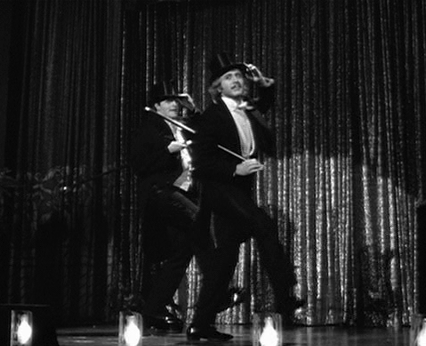
On the whole, though, I think I still prefer a rather more classic sort of Frankenstein parody.
Okay, a break for a while from all the heavy stuff, to say the solipsism of writing about my own writing. Here:
In all candor I must say I sort of miss old-style sexploitation, a genre of movies that seems to have flourished between the mid-1960s, when people got tired of the nudie-cuties and mid-1970s, after which time when moviemaking seems to have fissioned into mass market movies, which due to their mass-market character reach for a lowest common denominator with respect to erotic content (meaning, not much) and outright porn. I have nothing against outright porn, mind you, it’s just that as a thaumatophile I sort of like people who worked a bit, even at absurd pretenses, to get pretty girls out of their clothes and into peril, peril which often included mad science and its consequences. I guess I’ll always just get more out of Invasion of the Bee Girls than a lot of other movies that have more explicit sexual content. Oh where are the drive-ins and grindhouses of yesteryear?
Christine Nguyen here plays “Muffin Baker,” who in turn is playing a character in a movie within the movie (which we will later learn is called Missing in Acting). And she’s in trouble, tied to a table in the half-convincing-looking mad lab of a “Dr. Sin,” who I think I vaguely remember from graduate school.
Happily for our unnamed heroine she is soon rescued by a character named Bardo, sent straight from Central Casting’s “Weightlifter with a Machine Gun” division. Bardo is played by Nick Manning, the most relevant fact about whom I could find is that as of this writing he has 460 acting credits to his name in IMDB, which include Anal Ballerinas and My Teacher is a MILF.
After a bit of sub-Homeric narration by Bardo of his travails in rescuing the girl, we are treated to this bit of sparkling dialog
Muffin
How much time do you think we have until they blow us all up?
Bardo
Let’s not talk about killing. We only might have thirty minutes left until we ourselves are killed by those who we seek to kill.
Now you or I, dear reader, might have a variety of reactions to this interesting revelation, among which might be
Professionalism. Get busy killing those whom you seek to kill and who seek to kill you. A job is a job, damnit!
Self-preservation. Excuse me, but you didn’t happen to say “blown up,” did you? You did? In that case, would you excuse me for a moment? I need to slip into a comfortable pair of running shoes.
But you or I, dear reader, clearly would not be following the cinematic logic of the situation. Fred Olen Ray understands it however.
Muffin
Makes me melt when you touch me like that. Make love to me, Bardo.
Bardo
If we are to die, then let it be in each other’s arms.
Yep. Makes perfect sense.
And I know that all dedicated readers of this blog will doubtless look at that last image and think:
That dingus over there in the far right-hand side of the image. Is that the lab’s main power supply? What is it running? What is the experiment? Please tells us, Mr. Ray!
But unfortunately we never learn, because at that point Muffin’s director-boyfriend yells “Cut!” ending the scene and getting on with the main, and even sillier, movie.
Oh well. At least I understand that Fred Olen Ray has Bikini Frankenstein coming out, so maybe there’s something for us thaumatophiles to hope for.
As an ardent thaumatophile, I cannot but love the idea of a person scanner, and so does Iris, apparently.
The idea of a scanner that can take your information for re-creation of you later on somewhere else out of new matter is one that has played an important role in thinking about the metaphysics of personal identity. The beginning of Chapter 10 (“What We Believe Ourselves to Be”) of Derek Parfit‘s Reasons and Personscontains a famous example.
I enter the Teletransporter. I have been to Mars before, but only by the old method, a space-ship journey taking several weeks. The machine will send me at the speed of light. I merely have to press the green button. Like others, I am nervous. Will it work? I remind myself what I have been told to expect. When I press the button, I shall lose consciousness, and then wake up at what seems like a moment later. In fact I shall have been unconscious for about an hour. The Scanner here on earth will destroy my brain and body, while recording the exact states of all my cells. It will the transmit this information by radio. Traveling at the speed of light, the message will take three minutes to reach the Replicator on Mars. This will create, out of new matter, a brain and body exactly like mine. It will be in this new body that I shall wake up.
Happily this process works, and Parfit’s narrator goes through it many times, until one day…
Several years pass, and I am often Teletransported. I am now back in the cubicle, ready for another trip to Mars. But this time, when I press the green button, I do not lose consciousness. There is a whirring sound, then silence. I leave the cubicle, and say to the attendant, “It’ not working, what did I do wrong?”
“It’s working,” he replies, handing me a printed card. This reads, “The New Scanner records your blueprint without destroying your brain and body. We hope that you will welcome the opportunities this new technical advance offers.”
The attendant tells me that I am one of the first people to use the New Scanner. He adds that, if I stay for an hour, I can use the Intercom to talk to and see myself on Mars.
“Wait a minute,” I reply. “If’ I’m here I can’t also be on Mars.”
Someone politely coughs, a white-coated man who asks to speak to me in private. We go to his office, where he tells me to sit down, and pauses. Then he says “I’m afraid we’re having problems with the New Scanner. It records your blueprint just as accurately, as you will see when you talk to yourself on Mars. But it seems to be damaging the cardiac systems when it scans. Judging from the results so far, though you will be quite healthy on Mars, here on earth you must expect cardiac failure within the next few days.”
The attendant later calls me to the Intercom. On the screen I see myself just as I do in the mirror every morning. But there are two differences. On the screen I am not left-right reversed. And, while I stand here speechless, I can see and hear myself, in the studio on Mars, starting to speak.
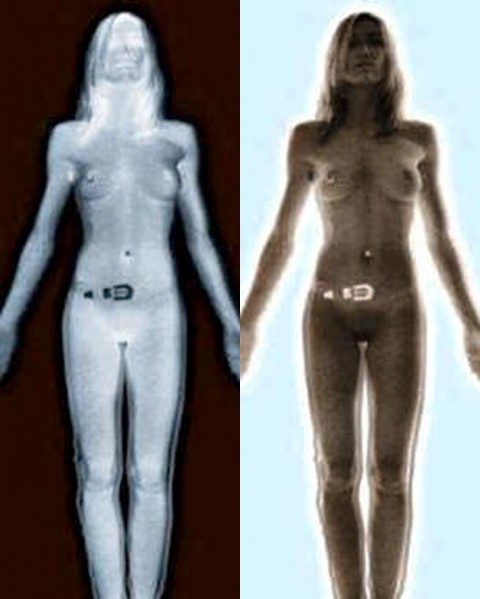
Get all that? Ponder it in your head for a moment while you savor another EroticMadScience picture of a scanner at work (though this one is real, not fictional, as you’ll see if you click through on the link).
The point of Parfit’s example is to sharpen (and challenge) our intuitions about what it means to be ourselves and survive as ourselves. There are many different possibilities, the most salient of which are physical continuity and psychological continuity. Since normally your consciousness and your body don’t separate, we don’t experience challenges of this kind in reality.
But Iris is smart. She knows that the two might be separated. Being forced to decide between the two possible theories is at the core of her disagreement with Professor Gregg in the prologue to Study Abroad. Gregg subscribes to a physical continuity theory of personhood, which is why he thinks that the permanently-vegetative “Tabitha Sibling” (fictitious, but arguably based on a real case) has the same moral status as “you or me.” Iris advances contrary to this the psychological continuity theory of personhood.
There is a problem, of course, which is that if we take a hard line on psychological continuity we might end up with a rather big bullet to swallow, to wit, that if we are in the position of Parfit’s narrator, we shouldn’t at all regret the fact that we are about to die of heart failure in a few days, because the guy on Mars is us, psychologically continuous with us, will have conscious experiences like ours, will carry on our projects, love our spouse, rear our children and so on just like we would have done.
Head spinning yet? Oh, but I’m not letting you off quite that easily. The same issues are entertainingly discussed further in a brilliant short film by John Weldon, called “To Be.” Watch at any time: unusually for something here at Erotic Mad Science, it’s completely SFW. As to whether it’s safe for your peace of mind, I make no warranties.
The awesome thing about Iris is that, unlike most philosophers, she is willing to put everything on the line, her very existence as a test of the theory she espouses. She (with a little boost with tolmemazine, perhaps? — that in itself poses an interesting philosophical problem) shows herself to be an absolutely fearless bullet-biter. This is experimental philosophyà l’outrance.
Just speculating here, but I’d bet that if in the real-world philosophers were half that courageous, philosophy would command much more respect.
ADDED 11 p.m. The woman in the scanner shot is apparently a hoax that appeared on both Gizmodo and Drudge Report so my “real” claim turns out to be wrong. But I at lesat hope the entertainment value remains, and, I think, the larger philosophical point raised by the post is unimpaired.
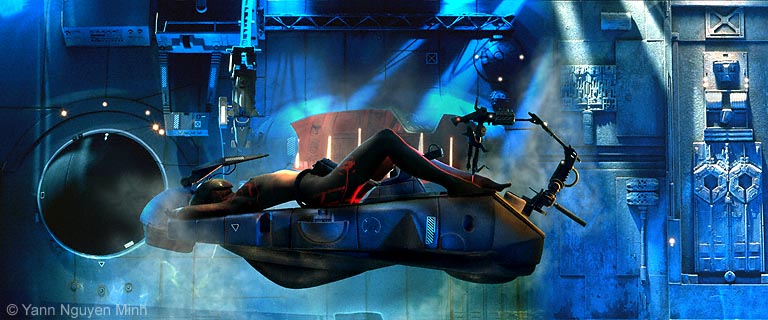
I am pleased to be able to add the site of Yann Minh, an extraordinary creator of erotic sci-fi content to the right. I’ve included a tiny thumbnail as a tease, and if you’re intrigued, by all means surf over.