New art for Erotic Mad Science

You might have noticed a few minor design changes here at EroticMadScience lately, as I’ve decided to go a level or so deeper in indulging my inner weirdness and commission art with an appropriate mad science theme.  (It’s always a good day, really, when you can spare something that’s merely money and get art in exchange.)  Most readily recognizable (since she now appears in the header bar as a sort of presiding spirit for the site) is this:

(Image above Creative Commons licensed.) Creative Commons License

Yes, it’s the Maschinenmensch from Fritz Lang‘s Metropolis, at a critical moment in her transformation into a virtual Maria.  Albeit done a little more explicitly than might have been possible for the big screen in 1927.

The artist who created this image is Hugo Araújo, working for Glass House Graphics.  [Faustus May 11, 2018: The original link for Hugo is dead, but there is a modest gallery of his work to be found here, and he has a blog here and a DeviantArt site here.] And I must say, if you ever want to do bespoke fantasy art of your own, I can recommend these folks highly.  They’re creative and they’re fun and a joy to work with.

Of course, where would robot Maria be without her mad scientist creator, also rendered for me by Hugo:
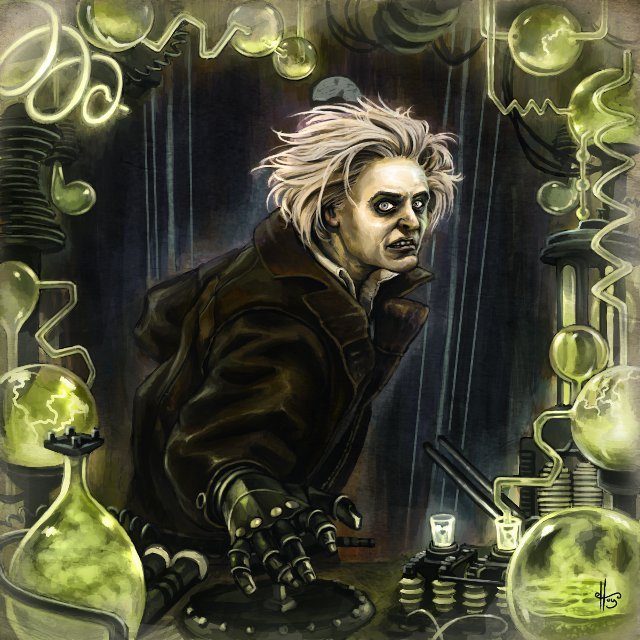
(Image above Creative Commons licensed.) Creative Commons License

Rotwang, that very image of the mad scientist.  I really like what Hugo’s done with all those glowing tubes.

I hope you enjoy these images.  I might commission more in the future.
Willy Wonka Mad Scientist V

The last horrid child to fall into a near-death trap is Mike Teavee, who’s a little too much into television.

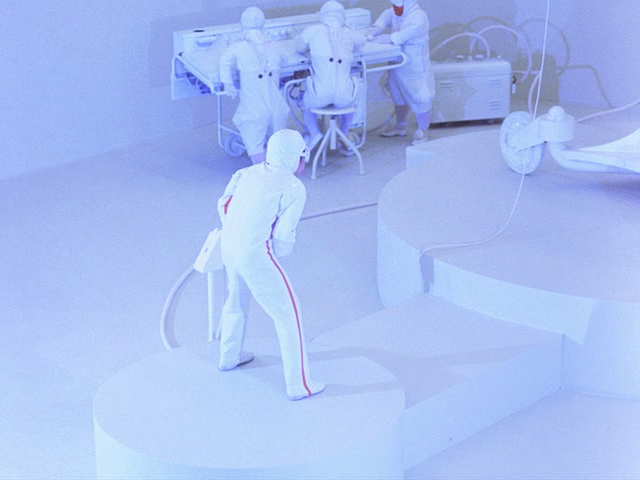
The setup is this.  Wonka has created a mad science technology that allows him to break down a physical object into tiny components and transmitted to a remote location — in effect, something like Star Trek‘s transporter device, save that it’s not really meant for people.  Wonka wants it simply to transmit chocolate bars to people’s TV sets — a form of advertising, you see.

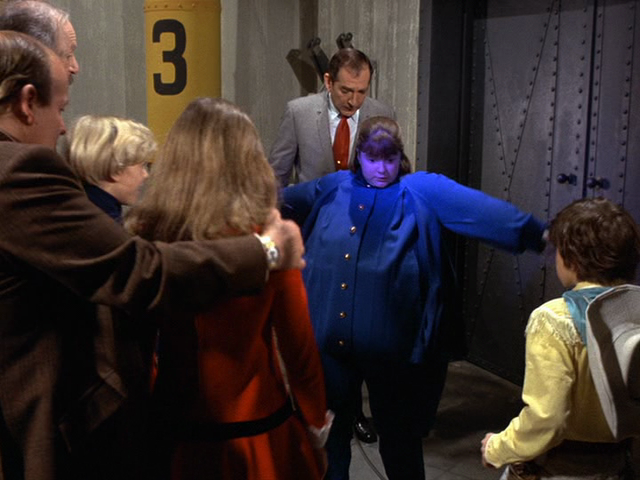
In the 1971 adaptation, Mike is a little overly fascinated by the prospect of being on television.

And this has a rather dangerous outcome.

In the end, Mike does end up reassembled.  Sort of.  The outcome of the process will be the subject of tomorrow’s post.

I’m pretty sure that I saw this scene as a child well before I ever saw an episode of Star Trek or any other use of a matter transporter in fiction.  Was I impressed?  Well, look around what I write:  what is the Apsinthion Protocol is a process of being broken down and re-assembled, here imagined as a sort of very elaborate sex machine.  More obliquely, the strange process Iris goes through is a kind of disassembly and reassembly.  The unnamed native girl in the ethnographic film footage watched by Maureen is disassembled, not to be reassembled exactly, but perhaps to be apotheosized.    And of course, my own response to the “how do you want to die?” question posed to me by W. in the Thaumatophile Manifesto involves my own participation in a self-inflicted transporter accident.

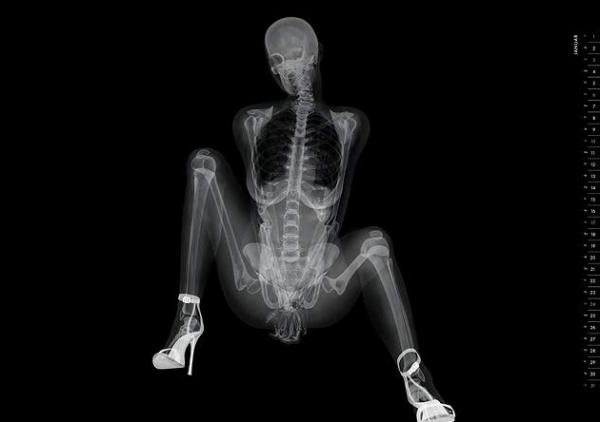
The 2005 adaptation of the same scene involves the use of a visual meme that should be familiar to readers of this blog.

But perhaps more interesting is the change in Mike’s motivation in this scene, which deserves, and will get, its own post.

Willy Wonka Mad Scientist IV

In the 1971 adaptation of Charlie and the Chocolate Factory, once each of the horrid children tumbles into their appropriate near-death trap, they drop out of the story and are not seen again.  We get only a verbal assurance from Willie Wonka that they will be okay.  (Should we trust that he’s telling the truth?)

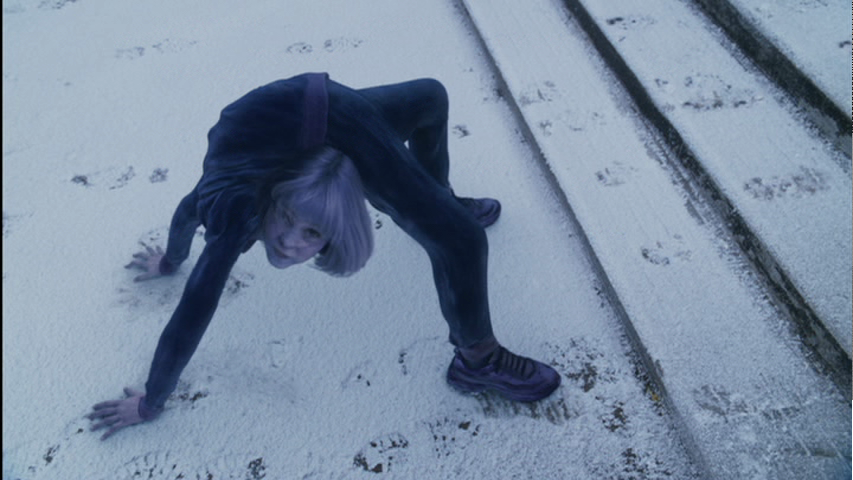
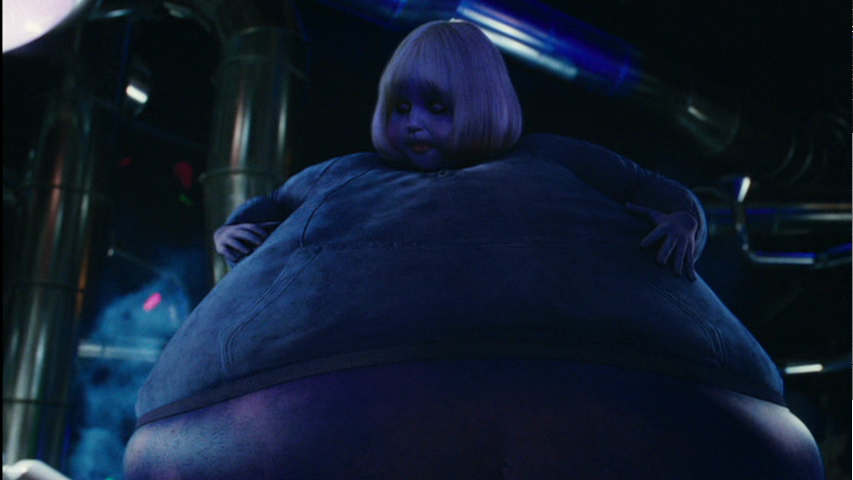
The 2005 adaptation does things a little differently.  We get a brief scene of the horrid children leavening the factory with their mortified guardians.   Some have undergone…changes.  Violet in particular, after having been blown up into a blueberry and then (off camera) “juiced,” isn’t quite the same girl who went in.  She’s changed color, for one, and for another is now really, really flexible.

She actually seems rather pleased with her transformation, a sentiment which would fit rather well with the ethos of the Gnosis College fictional world.

Fetish fuel for a new generation, indeed.

Willy Wonka Mad Scientist III

Another of the horrid children nearly done in by Willy Wonka mad science is named Violet Beauregarde, who has a bad habit of excessive gum chewing.  She seizes a piece of experimental chewing gum –billed by Wonka as “a whole meal in a stick” — and promptly starts chewing it.  That would seem to be a violation of experimental safety protocols.  That is, if Wonka’s factory had such a thing as safety protocols.

Things go swimmingly for Violet until the end, where the blueberry pie part of the meal produces a certain side effect.  In the 1971 version:

Violet blows up like a blueberry.  Fetish fuel for a new generation:

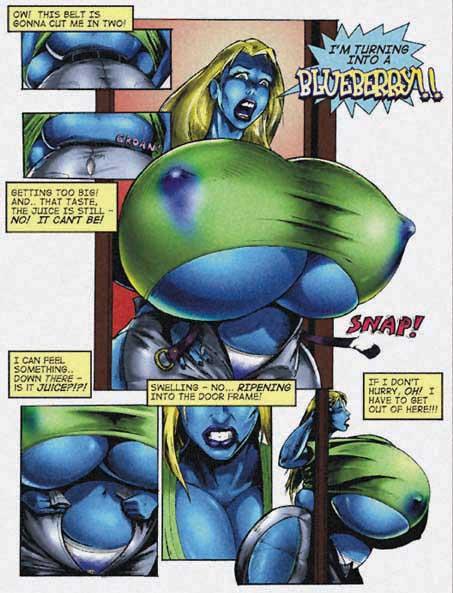
Why fetish fuel?  Well, as it turns out, there is actually a fetish for body inflation.  I’ve written about it some at ErosBlog before and there’s a decent discussion of it also in Agnès Giard‘s Le sexe bizarre (on pp. 116-7, under the subhead “J’ai le cœur qui fait boum”)  And Violet’s experience even inspired a bit of a fetishistic comic book called The Adventures of Berrygirl, in which an unsupecting college coed is slipped a bit of Wonka’s not-quite-perfected gum and…

You can find more of the story at this body-inflation page.

Willy Wonka Mad Scientist IIA

A footnote to l’affaire Gloop, if you will.  Like many kids, I didn’t just watch the 1971 movie adaptation of Charlie and the Chocolate Factory.  I went to the source text by Roald Dahl, where I found glosses on the the whole Augustus Gloop incident like this:

“Mr. Wonka doesn’t seem to think so!” cried Mrs. Gloop. ” just look at him.  he’s laughing his head off!  How dare you laugh like that why my boy’s just gone up the pipe!  You monster!”  she shrieked, pointing her umbrella at Mr. Wonka as though she were going to run him through.  “You think it’s a joke, do you?  You think that sucking my boy up into you Fudge Room like that is just one great big colossal joke?”

“He’ll be perfectly safe,” said Mr. Wonka, giggling slightly.

He’ll be chocolate fudge!” shrieked Mrs. Gloop.

“Never!” cried Mr. Wonka.

“Of course he will!” shried Mrs. Gloop.

“Because the taste would be terrible,” said Mr. Wonka.  “Just imagine it!  Augustus-flavored chocolate coated Gloop!  No one would buy it.”

That’s on pp. 75-6 of the 2007 Puffin edition, if you care.

All these years — decades, really — later I reflect and wonder if this naughty cannibalistic image didn’t create in my head scenes like this from Gnosis Dreamscapes.


int. an industrial set inside “hygeine and you” – day

Professor Wagstaff stands with LITTLE BOBBY, a boy of perhaps eleven, watching cans coming down a conveyer belt through a hole in the wall.

little bobby

Gee, Professor, this isn’t quite what I expected.

Little Bobby picks a can off the assembly line and looks at it.

close-up: a can

The lable has a picture of a smiling, well-scrubbed and properly coiffed Marcia on it, with the legends CANNED MARCIA and AS SEEN ON T.V. on it.

back to scene

PROFESSOR WAGSTAFF

Well, little Bobby, let that be a lesson to you. Always check the settings on the machine before you start.

LITTLE BOBBY

I will, Professor. I promise.

What a tangled thing our psyches are.

Willy Wonka Mad Scientist II

If there are any among you who don’t know the core plot behind Roald Dahl‘s Charlie and the Chocolate Factory or its various film adaptations, it is this.  Eccentric industrial chocolatier (and, as I would argue, first rate mad scientist) Willy Wonka sets up a world-wide lottery that picks five children (with one guardian each) to go on an exclusive tour of his rather strange and dangerous factory.  Four of the lucky winners are beastly children whose misbehavior leads them to get into near-fatal trouble.  The fifth is the penurious but angelic Charlie Bucket, whom Willy Wonka adopts as his heir at the end.

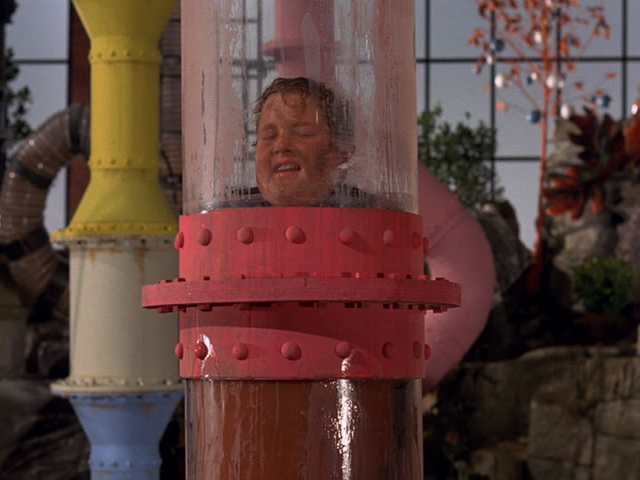
The first beastly child to get in trouble is Augustus Gloop, a gluttonous boy unable to resist the temptations of Willy Wonka’s chocolate river.  Unsurprisingly he falls in and is promptly sucked up into one of the river’s effluent pipes wherein, due to excessive girth, he gets stuck for a while.  In the 1971 film version, he looks like this:

What’s beneath him is high-pressure liquid chocolate (he’s lucky to have been sucked up head-first!) which will eventually push him up through the tube to a destination elsewhere in Wonka’s factory.

One obvious fetish that will be fueled by this scene is something called wet and messy fetishism, arousal brought about by being coated in messy fluids or semi-fluids, chocolate being a popular choice.  It’s not something I know much about, but if you wish to suggest interesting resources in the comments, then by all means dive right in.

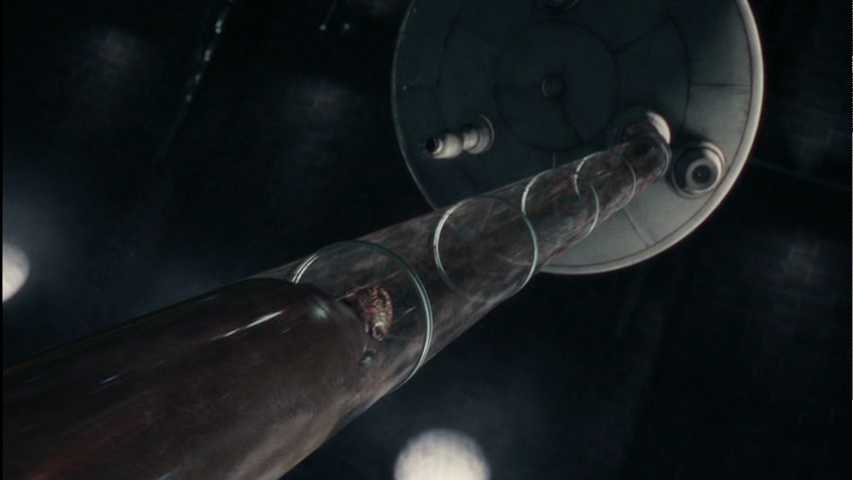
Fetish fuel for a new generation came in the 2005 version:

The prop designers deserve extra credit on this one, because the tube empties into a transport vessel that looks a lot like a flying saucer, thus giving the scene an additional alien abduction overtone.  Some people are into that.

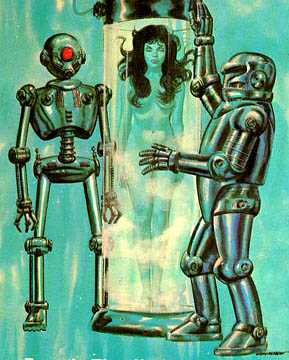
Of course there’s another bit of fetish fuel linked to girls in tubes, something for which these scenes provide a visual reference.  Now I’ve certainly covered girls in tubes here at Erotic Mad Science quite a bit, so surely I’m not going to do it any more, am I?

Oh, please, just one more image?  This one has robots in it as a bonus.

Found at Janitor of Lunacy, where else.

Willy Wonka Mad Scientist I

If you were to ask someone to name a mad scientist you’d be unlikely to get the answer “Willy Wonka.”  What an injustice!  Because in many ways Wonka is just much a mad scientist as Dr. Frankenstein or Rotwang.  He isolates himself from society, surrounds himself with grotesque assistants, and experiments away endlessly with bizarre substances which can have truly radical effects on those who consume them, wittingly or not.  Also, like a mad scientist, his morality is rather at variance with accepted social norms:  surely no normal person would allow children to play around  in close proximity to a variety of near-death traps into which they fall, repeatedly, right in front of their horrified parents.

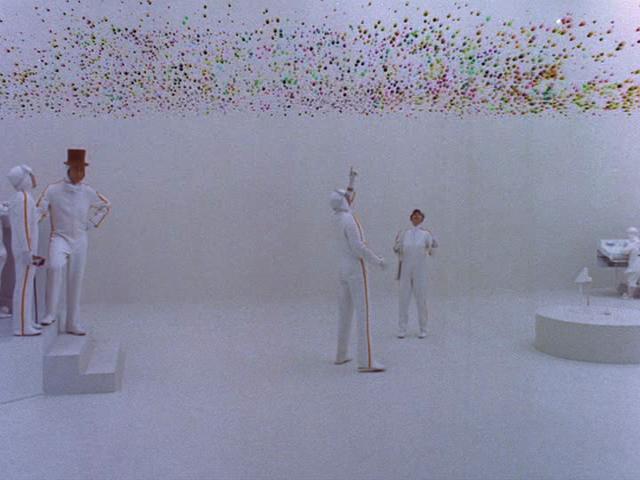
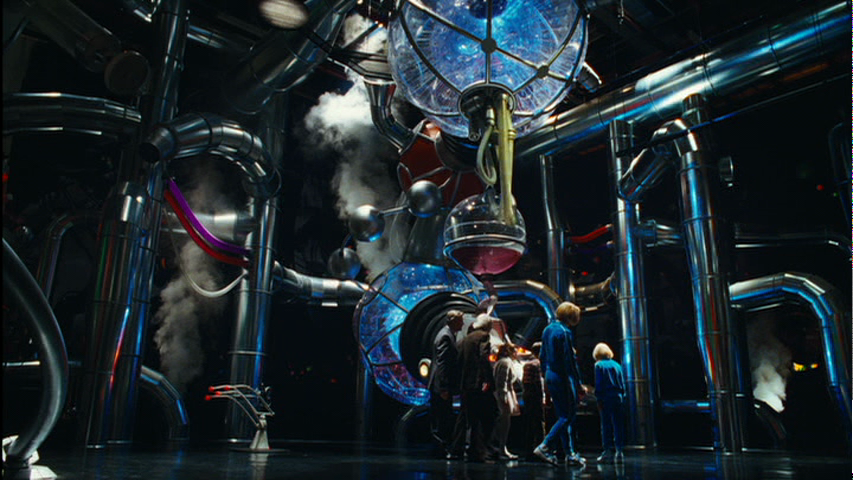
And also, try looking at the cinematic versions of Willy Wonka’s invention workshops and just try telling me that you’re not looking at an imaginatively arranged mad lab.  Here is the 1971 version:

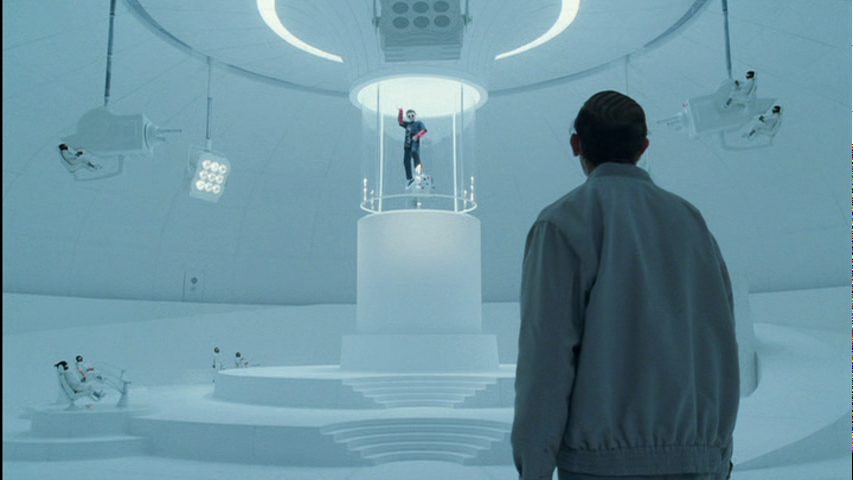
And the 2005 version

If that’s not mad science in action, I’ll eat a case of Slugworth‘s.

But does any of this belong at Erotic Mad Science?  I mean, these are children’s movies, right?

Only half right.  These works might have been largely intended for children, but they clearly left impressions in the minds of young viewers which weren’t erotic experiences at the time they were seen, but which lingered and would eventually become fetish fuel — things not erotic in themselves (at least, not intended that way and probably not seen that way by most viewers), but which would eventually form the visual or conceptual anchors of fantasy.   Fetish fuel is a concept I’ve implicitly worked with before, in the context how an old monster movie might have affected people’s sexual imaginations.  I shall be posting on a few examples of it in the Willy Wonka/thaumatophile context over the coming week.


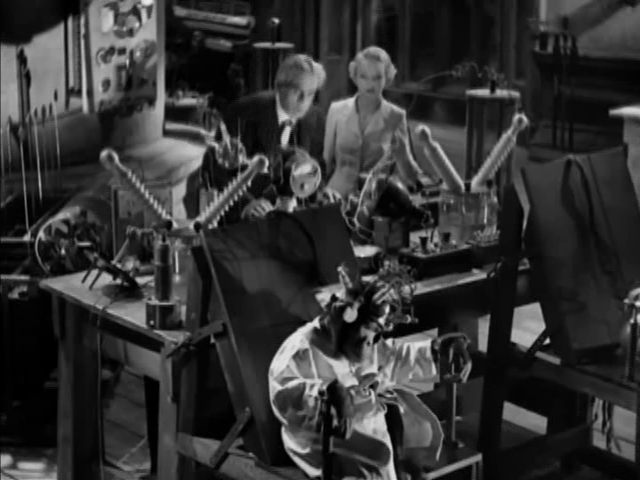
Bonus early mad science

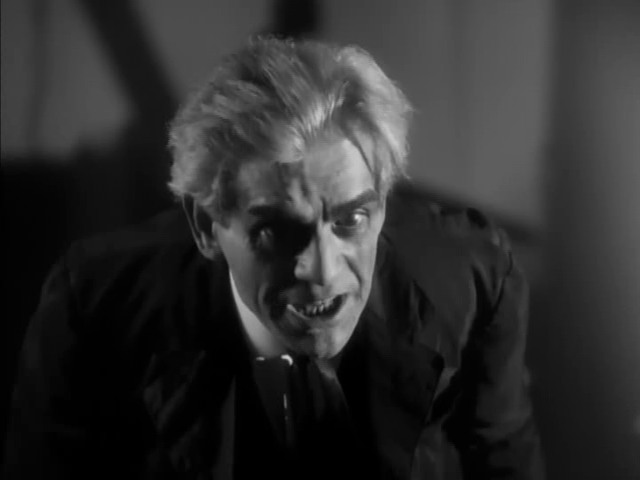
While we’re on the subject of old cinematic mad science that deserves attention, I should bring up The Man Who Changed His Mind, a 1936 feature that starred Boris Karloff, who had recently given a type-creating performance as Frankenstein’s monster and who now gets to be the mad scientist, “Dr. Laurience.”

Providing appeal here is Anna Lee playing Dr. Clare Wyatt, who goes to assist Laurience, believing him to be (mostly correctly) a misunderstood genius.

Laurience, it turns out, has been working with a mind-transfer technology, which he demonstrates to the skeptical Dr. Wyatt through animal testing (unusual prudence for cinematic mad science!) in a well-done mad scientist laboratory scene.

Things spin out of control, as they have a way of doing in the movies.   An ambitious press baron (literally — he is Lord Haselwood) undertakes to finance Laurience’s work, but when Laurience attempts to present his results to the assembled scientific community, he is laughed off the stage.  The furious Lord Haselwood pulls Laurience’s funding, which causes Laurience to throw caution to the winds by testing his mind transfer device on…Haselwood and Laurience’s own crippled assistant Clayton… with success.   It will get worse for the good characters from there on out, because Laurience is falling in love with Dr. Wyatt…who is in turn attached to Lord Haselwood’s journalist son…

I’m slightly surprised that this movie doesn’t have a higher profile than it appears to have.  Karloff gives a strong performance, though perhaps I’m biased toward sympathy with his character (I’ve had my own moments when I realized that professional failure loomed at the same time as I realized that the One You Love Does Not Love You, resulting in a form of inner anguish I wouldn’t wish on the worst person alive).  And Anna Lee is not just eye candy here.  She plays a character who’s a competent and strong-willed scientist in her own right (the opening scene depicts her performing surgery), and obviously there’s appeal there.  (Plus a plot twist that I’ll run under the fold to avoid spoilers…)

Definitely a film to watch, if you want to know the mad science cinematic canon.  It’s available at the Internet Archive and also embedded below:

Personally appealing bit of trivia: The movie was directed by Robert Stevenson, who would have a long, long career that ended with…The Shaggy D.A., which as I recall is the story of a man who finds his mind in the body of a dog.  So I guess history rhymes here…

Additional personally appealing bit of trivia: Anna Lee would have an even longer career and continue acting into her nineties, which I think is awesome.

Bonus plot element below this fold…

Continue reading