It was my pleasure to have appeared on another episode of the Grindbin Podcast. Mike and the McCollum boys and I take a deep dive into what may well be the most depraved women-in-prison movie of all time, Bare Behind Bars. (Seriously, it makes Ilsa, She-Wolf of the SS look like an arthouse movie.) You can download the episode here or subscribe to ‘Bin on your podcast app of choice. As with most of my appearances on the ‘Bin, I am making my notes on the episode available for download.
Our cover art for the episode is again by the lovely and talented Lucy Fidelis.
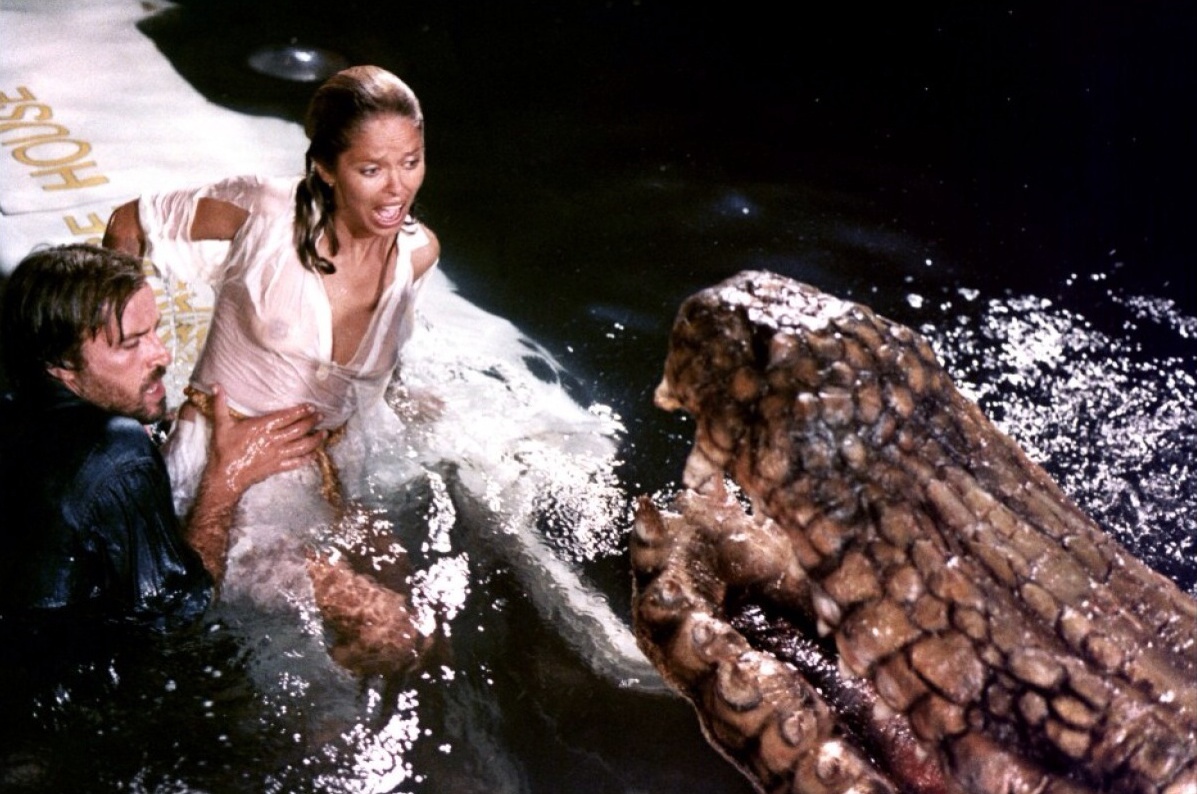
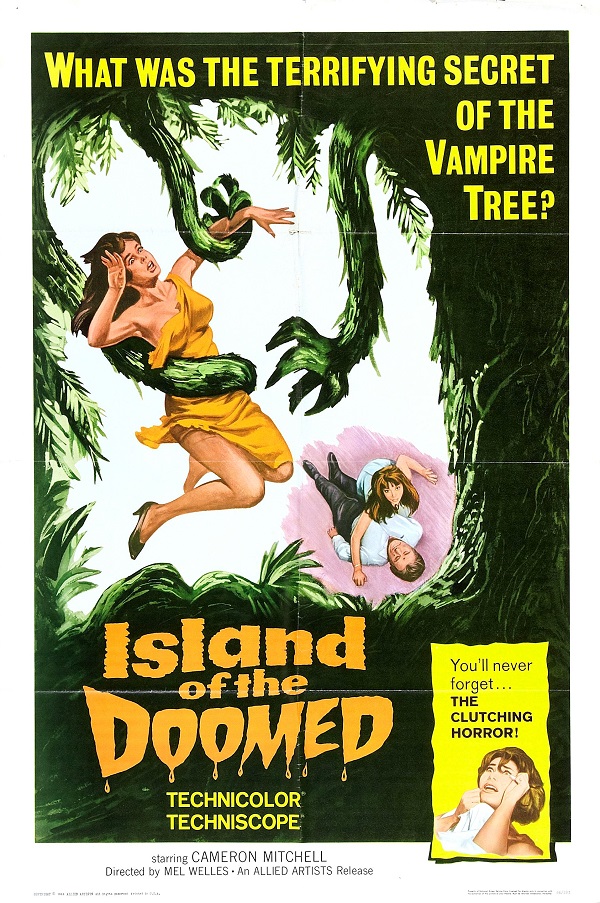
No one does sexpolitation quite like Italian moviemakers do sexploitation, as the post above, from the 1979 movie The Great Alligator River surely shows. Although I’m not sure that anything in the movie goes to quite this exploitative level (I haven’t seen it), at least one still suggests a willingness to go there, so to speak:
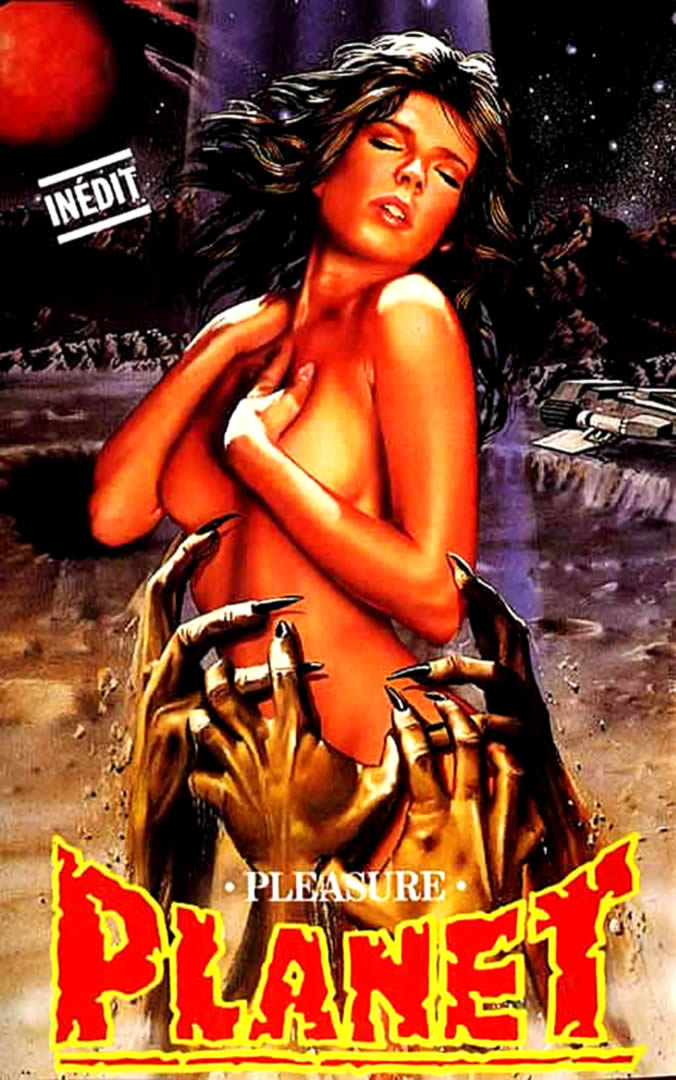
This image is reblogged from this 19 July 2015 post at Infernal Wonders. Various roundabout searching leads me to believe that the movie it is advertising was principally known at Vicious Lips (1986), a production sufficiently obscure that it doesn’t even have a Wikipedia entry. One of its IMDB reviewers insists that you’ll really like it if you’re into big hair.
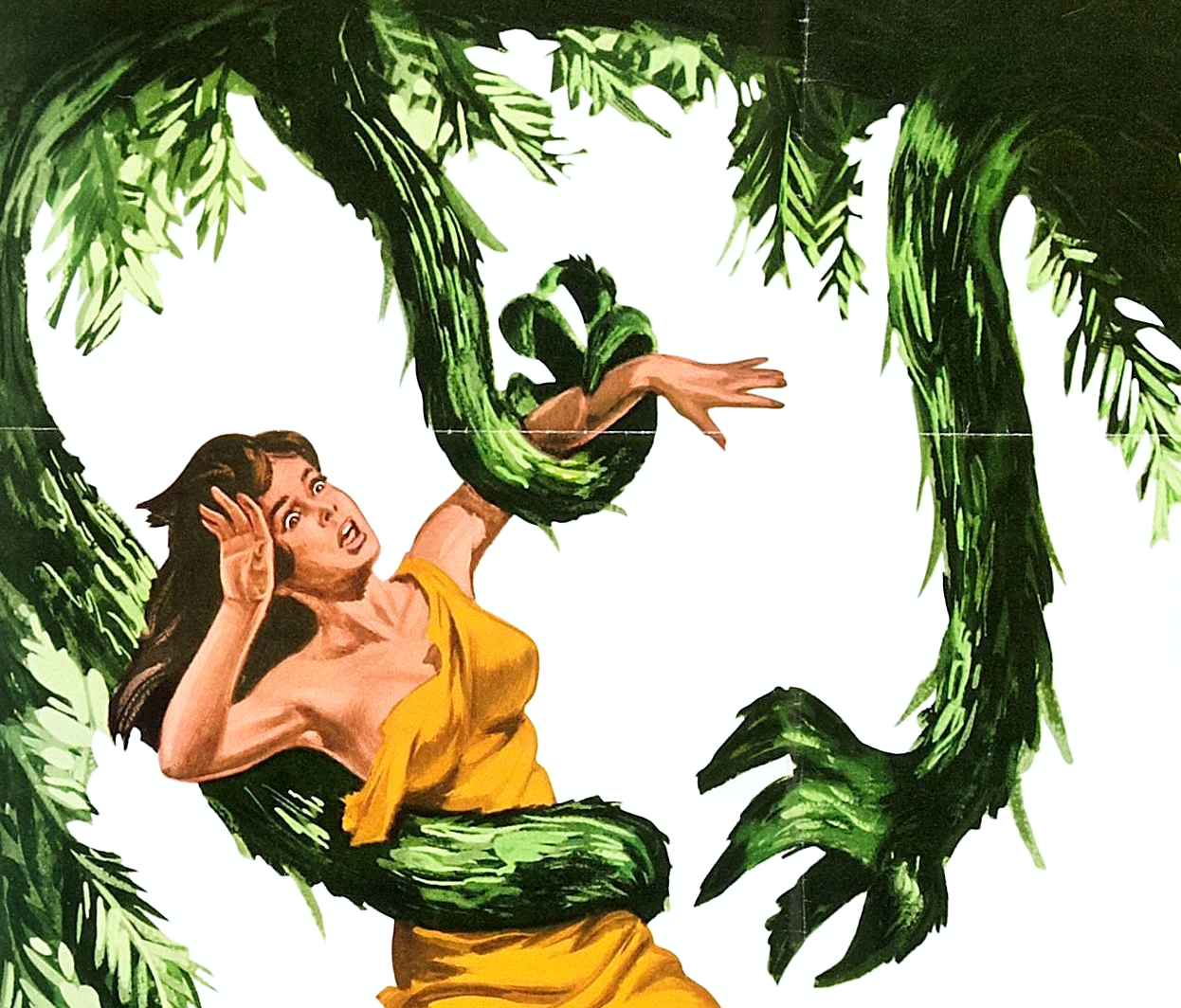
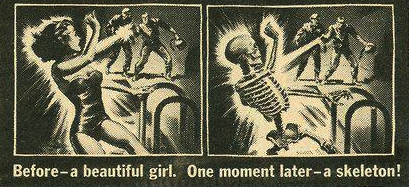
First blogged by me in this 22 December 2013 post at Infernal Wonders, this little pair of illustrations appears to be promotional art — possibly run in local newspapers — for the 1959 sci-fi cheapie Teenagers from Outer Space. I’ve seen this movie (or at least, the send-up of it done by MST3K), and I can attest that it does at least have the scene promised by the advertising. If you really want to, you can watch or download the movie the Internet Archive, or watch it as embedded here:
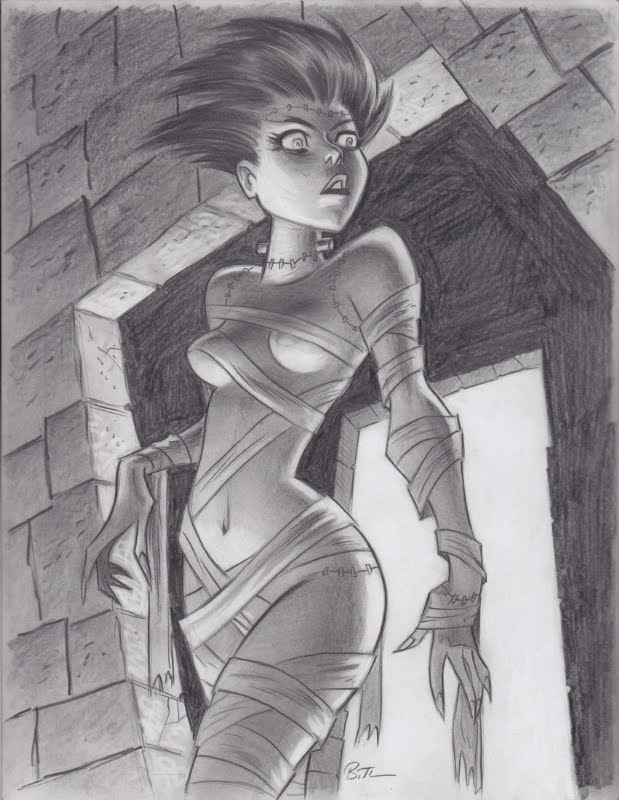
Some of you might have encountered writer and film buff Steve Miller’s 150 Movies to Die before You See, which sure sounds like the sort of thing someone who reads this site should have on his shelf. Well, I am pleased to report that this distinguished reviewer has not just a site, but a whole darn network of sites of reviews and commentary and very tasty imagery well worth your time if you like what goes on here. There’s Terror Titans (horror movies), Watching the Detectives (hard-boiled private eye and spy stuff), Movies to Die Before You See (pretty much self-explanatory), The Universal Horror Archive (lot of horror, including some classic mad science), and Shades of Gray (black and white fantasy art, which should be appealing to those of you who enjoy Lon’s fine black and white work on Tales of Gnosis College). From the last, I can’t resist a swipe of some splendid mad science found there, an illustration by Bruce Timm.
And all this wonderfulness is packaged up for you at Cinema Steve, which now occupies a place of honor over on the blogroll. Do something nice for yourself and surf over to take a look.
It’s inevitable that I would be viewing a movie that’s sometimes marketed as The Erotic Rites of Frankenstein (more properly La maldición de Frankenstein, 1972). True, it was written and directed by Jesús Franco, a filmmaker with a reputation for being a real schlockmeister, but that’s hardly a disqualification here!
An oddity of this movie is that it seems to exist in two versions, a “clean” version without nudity and a “dirty” one, in which whole scenes in the clean version appear to have been re-shot with naked actors. The “dirty” version, at least the one I was able to find as bonus material on my DVD version, has very low print quality — fuzzy images and poor lighting. The “dirty” version also appears to have some complete sequences that were cut from the “clean” one entirely.
In some ways the “clean” version might actually make for more interesting Erotic Mad Science cinema, because it gets us to focus on concepts. The movie’s unusual plot involves Dr. Frankenstein busily tuning up his massively muscled, silver -skinned monster (which actually appears to be loyal to him), and being stone-cold murdered by some sort of demonic individual called Cagliostro and his hideous (well, in a squick or squee sort of way) bird-woman companion Melisa. They then kidnap (!) Frankenstein’s monster and wrest him from his loyalty to his late master using Cagliostro’s “magnetic” powers.
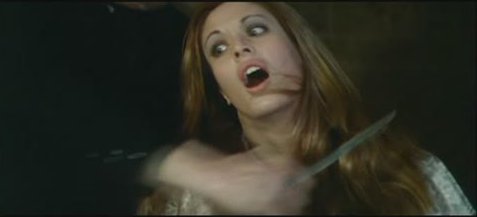
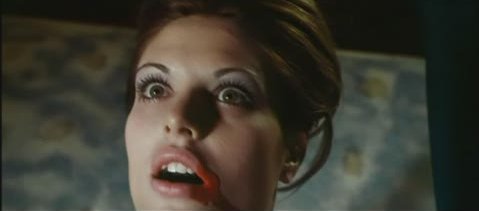
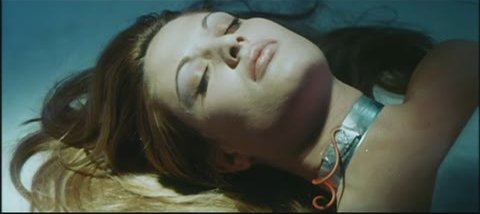
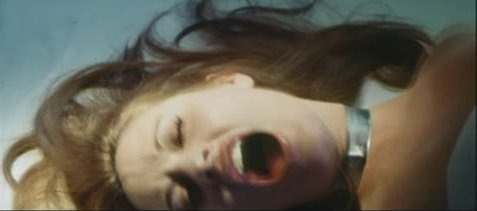
The monster is then dispatched on the errand of raping and abducting pretty women, who are to be brought back to Cagliostro’s castle where they are to be…well, used for parts. One of them, played by Britt Nichols, puts on a great “woman in peril” face in her final moment.
Which somehow is even starker as a (supposedly) decapitated head.
But don’t worry. As we shall see, she’ll live again. Sort of. These relatively crisp images are from the “clean” version. In the “dirty” version, the camera gives us a close-up panning full-frontal shot whose poor lighting presents too many technical challenges to reproduce here.
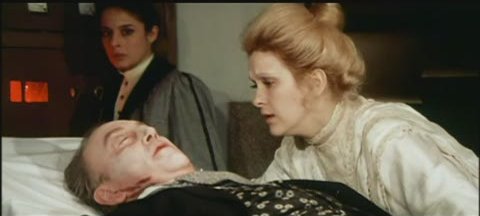
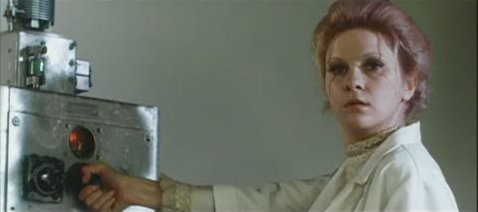
Fortunately for the forces of good, or at least the forces of less evil, Dr. Frankenstein has an avenger in the form of his own daughter, Dr. Vera Frankenstein (played by Beatriz Savón), who just by the merest chance, happens to be a hot scientist in her own right. She responds to her family tragedy like any devoted child would: she digs up her father’s corpse and hauls it into the laboratory for a session with the Fixation Ray. The Fixation Ray was what the elder Frankenstein used to animate his monster. As Vera demonstrates, the Fixation Ray can also be used to provide prompt, temporary relief from the symptoms of death. Long enough to ask Dad who was killed by, anyway.
Finding out that it’s Cagliostro who’s to blame (and isn’t it always), Vera pulls a move worthy of a Gnosis College heroine. She substitutes herself in the place of one of Cagliostro’s victims, getting herself abducted by the monster for the purpose of infiltrating his castle. This works…right up to the point where she’s unmasked.
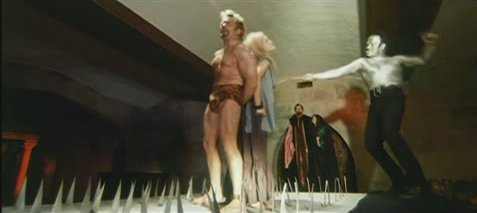
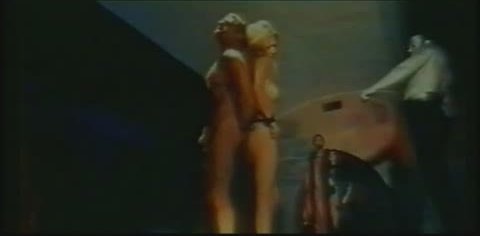
Things are pretty tough for Vera from there. She is tied back-to-back with a minion of Cagliostro who in typical evil-minion fashion has failed his master at a critical moment. The pair is then placed inside a field of giant, poisoned spikes and flogged by the monster. The first to fall, dies. Even in the “clean” version the resulting spectacle is pretty damn kinky.
Naturally there’s also a “dirty” version.
After Vera survives (and also possibly after a “send her to my chamber” episode that only exists as a fragment on my DVD’s extras) she’s subjected to Cagliostro’s mind-control powers and put to work, using the parts Cagliostro has been accumulating to construct and animate a “perfect woman,” whom he intends to mate with Frankenstein’s male monster for the purpose of creating a new master race. (Oh, how very original.) At least Cagliostro picked the parts well.
Hot scientist at the ready.
And in the “clean” version we see this:
And the dirty version this:
But things don’t quite work out for Cagliostro, because the monster’s residual loyalties to Frankenstein kick in just as he’s about to made with electro-woman and he runs around smashing stuff up. Cagliostro drives off laughing maniacally, apparently to his death, except that it’s not really his death because somehow he’s managed to impregnate Lina Romay, who’s otherwise spent the entire movie wandering around in a meaningless detached subplot and will be reincarnated in the body of the child she’ll give birth to. Or something. Way to wrap things up there, Jesús.
But still that’s Erotic Mad Science for you. Though for my money it’s Vera Frankenstein that makes the DVD worth the price. Not so much for what she looks like with her clothes off, though I’m certainly not complaining about that, mind you. It’s for what she does and represents, and for her uncompromising commitments to mad science and throwing herself into danger. You’re a true thaumatophile when you understand why all that matters…
You might recall a warning from a few days ago that when you go fetish fuel mining in old pop culture you might get a bit dirty. That’s sort of how I feel about today’s post, but somehow I can’t resist the underlying material all the same.
The character of Fu Manchu is one of the earlier characters one might call a supervillain. He was created in 1913 by the English novelist Sax Rohmer (1883-1959), and he must have scared the willies out of contemporary audiences as the embodiment of some rather deep fears. As Rohmer’s protagonist Nayland Smith described him in The Mystery of Dr. Fu-Manchu:
Imagine a person, tall, lean, and feline, high-shouldered, with a brow like Shakespeare and a face like Satan, a close-shaven skull, and long, magnetic eyes of the true cat-green. Invest him with all the cruel cunning of an entire Eastern race, accumulated in one giant intellect, with all the resources, if you will, of a wealthy government—which, however, already has denied all knowledge of his existence. Imagine that awful being, and you have a mental picture of Dr. Fu-Manchu, the yellow peril incarnate in one man.
Yes, I’ll agree that racism really burns here — a topic I’ll be returning to shortly, I promise. But for the moment, I’d like to focus on Fu Manchu as an early cinematic erotic mad scientist. Obviously, here was a subject that Hollywood could not resist.
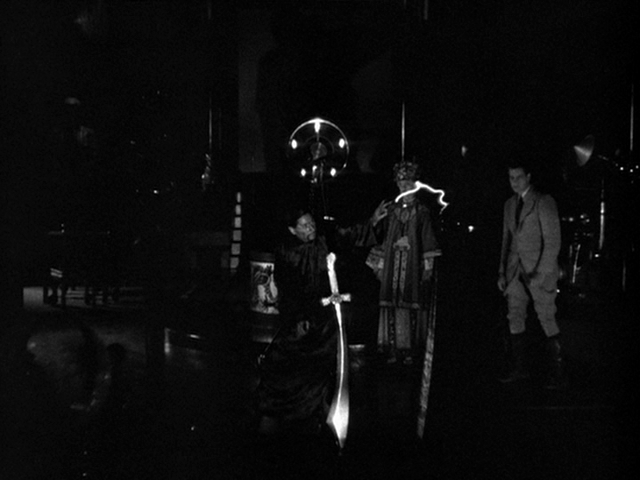
The instance I have in mind here is The Mask of Fu Manchu (1932). The plot revolves around the struggle between a group of British archaeologists and Fu Manchu over possession of a mask and scimitar that supposedly belonged to Genghis Khan. Fu Manchu believes that with them he can be recognized as the new Genghis Khan and rouse the masses of Asia to rise up and wipe out the white people of the world. Because of course everyone in Asia can instantly recognize centuries-lost artifacts as genuine on sight, right? Hey, I didn’t say the plot had to make any sense. What I’m here for is the erotic mad science.
Which we get in satisfying doses, this being a pre-Code production. Fu Manchu is in fact an accomplished scientist, possessing at doctorates in “philosophy from Edinburgh, law from Oxford, and medicine from Harvard.” (In spite of this, not a single white character in the movie addresses him as “Dr. Fu Manchu.” That’s a jerk move on their part. I’ll take the opposite tack and pay him the respect one man of learning owes another and include his honorific for the rest of the post.) He’s played by Boris Karloff, who, while he doesn’t look noticeably Chinese, at least can be said to have appeared on this site before. Also, he gets the mad science thing going good, testing a candidate scimitar with the power of SCIENCE.
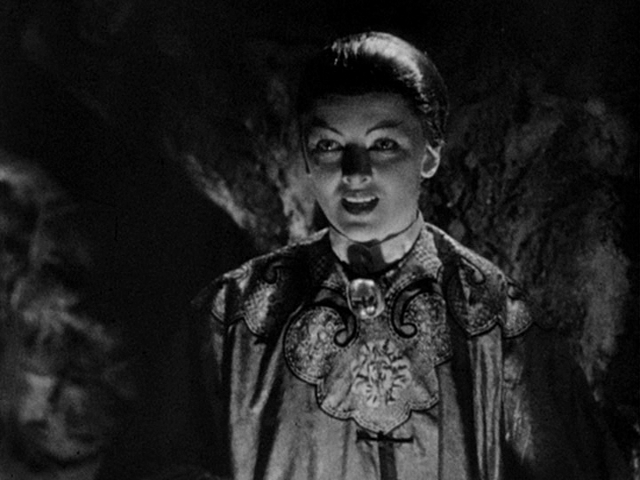
And Dr. Fu Manchu also has a daughter, Fah Lo See, played by Myrna Loy, who’s also not noticeably Chinese, but at least is fun to watch. Especially when she’s supervising the flogging of one of the English guys, which I must say, she really gets off on.
You’re a long way from Nora Charles here, Miss Loy. There’s a single YouTube clip which shows both exciting events, which I’ll attempt embedding here.
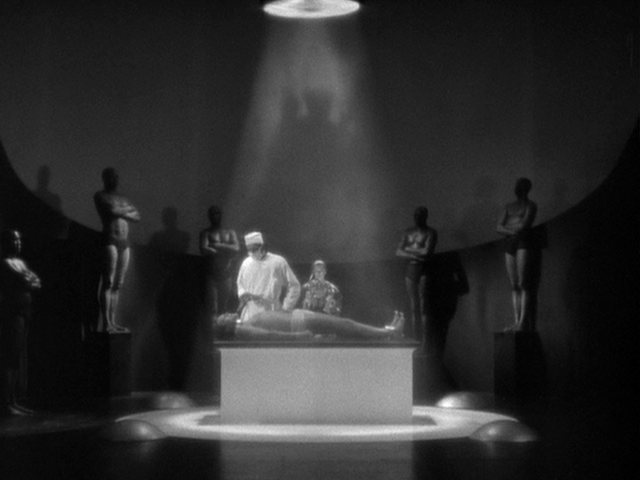
We also get to see Dr. Fu Manchu show off his surgical skills when he injects flogging-guy with a mind control drug. I’ve seen a commenter who identifies the scene in which it happens as “the most homoerotic surgery scene I’ve ever seen.” I must say I’m hard-pressed to disagree.
The guys standing around in short-shorts are big-muscled African men. Since the action for this film is set deep in the interior of China in 1930s, I’m not really sure exactly how Dr. Fu Manchu managed to recruit them. Perhaps there was some sort of special agency for that. I’m also not sure why they have to stand around like that, although they sure look cool doing it.
So anyway things spiral downward for the British Empire as Dr. Fu Manchu manages to capture the pretty blond (of course) girlfriend of our hero and set her up for a blood sacrifice (of course).
Would you all have maidens like this for your wives?
(pauses while the assembled crowd roars approval)
Then conquer and breed! Kill the white man and take his women!
Well, naturally we can’t have that now, so Nayland Smith escapes from the overly-elaborate, easily-escapable deathtrap which the genius but not-genre-savvy Dr. Fu Manchu has placed him in and saves the day.
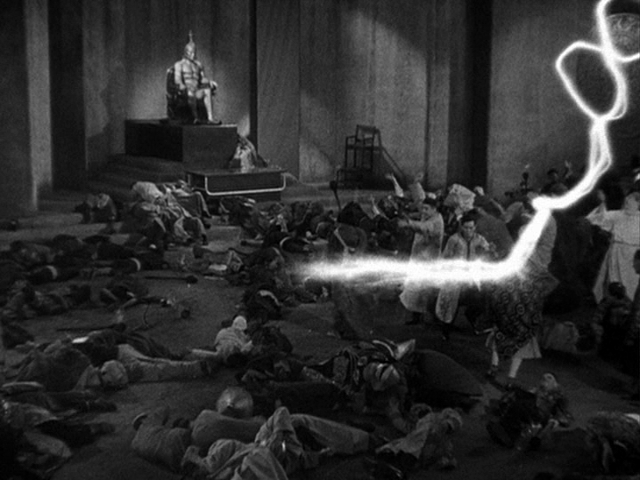
By using an energy weapon created by Dr. Fu Manchu to massacre a lot of Asian men who haven’t really done anything. We sure know where this movie’s value system is.
Yeah. Dirty, and not in a good way.
But of course, the awfulness can’t really stop there. There’s a concluding scene on a ship back to England, in which Nayland Smith has a conversation with a steward who’s just arrived to inform everyone that dinner has been served.
nayland smith
Good evening.
steward
(in an affected “Chinese” accent)
Good evening, sir.
nayland Smith
You aren’t by any chance a doctor of philosophy.
The Steward laughs and shakes his head in negation.
nayland smith
Law?
The steward shakes his head again.
nayland smith
Medicine?
steward
I don’t think so, sir.
nayland smith
But are you sure?
steward
Oooh yes. Very sure.
(laughs again)
nayland smith
(shaking the Steward’s hand)
Then I congratulate you.
steward
Thank you.
(walks off, banging a gong and calling out)
Dinner is served!
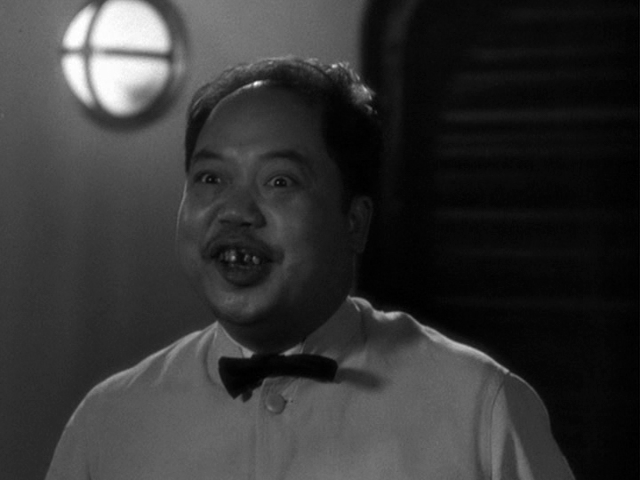
Yeah, yeah. I get the point the filmmakers clearly wanted to make here. Educated and competent Asian: bad. Servile and comical Asian: good. And if you don’t believe me, take a look at the steward himself.
Do you think that there were no Asian actors in 1932 with decent dentition available, or was this some sort of casting choice meant to drive home a certain point?
You know, I’m beginning to sympathize with Dr. Fu Manchu’s point of view. If I had to live in a world full of people who took this who think my role in life is to be servile and hold my life cheap because of my ethnicity, I’d be seriously pissed off as well. I wouldn’t go for genocide (I think — just how attractive are the enemy’s women again?), but a delivering a serious collective ass-kicking would be a formidable temptation. Evidence, perhaps, of Dr. Fu Manchu as a mad scientist motivated at least some by woundedness.
From the title of the post, what did you think I had in mind?
(Found on a pop-up laden site I shan’t link to.)
Actually it was something a little different.
However strange you are erotically, you’re almost certainly not alone. There are people like you, and they have been creating stuff in the past. And now it’s buried. It might be buried because it really was erotic in some way and the creators had to get it past the censors somehow. Or it might be buried because it isn’t erotic to many people but it is to some. Or it might just be lost, because it’s stuck inside popular culture that isn’t really very interesting or very good on the whole and so is largely forgotten.
But whatever it is, it’s out there, and if you’re diligent you can go out and dig it up and bring it back to life. If you’ve been following Erotic Mad Science for any length of time you’ll have noticed my doing it a lot. I’m into this weird thing with mad science. The evidence is strong that there were a lot of people in the past who were as well. But of course they were weird and unacceptable and so they had to get their crap past the radar somehow if they wanted it to see the light of day.
Crap past the radar: The tube girls are a good example. If you were a sci-fi or fantasy editor working in mid-twentieth century America, you sure couldn’t get away with putting a naked girl right on the cover of a magazine. But a tube, properly constructed, has some interesting properties. It’s transparent, but on obvious way of constructing one involves segments held together by metal rings. So you can put a naked girl in one, and of course her naughty bits will just happen to align with the metal rings. And of course, the tube will play a part in the story: she’s in cryo-sleep! Being abducted by horny aliens! Undergoing a transformation experiment! Presto: your porny art fantasy slips past the censor and onto the cover, which I am sure is most gratifying for both the viewer and for you. Before you know it, there are tube girls everywhere.
Half a century later, a weirdo like me an go collecting them in service of his own ends.
Forgotten fetish fuel: The “personal identity porn” thing is probably not unique to me (I’ll admit it’s weird as a subset of my weirdness) and people who were making movies like The Four-Sided Triangle or Frankenstein Created Woman probably didn’t have weirdos like me in mind when they were filming (although you never really know). They were making movies to make money. Like most pop culture, they were mostly forgotten in a while. But they were not gone, and they were there for me to mine up. Watching these movies, and then being to explain what I think is interesting about them from a thaumatophile perspective, allows them to live again under a new interpretation, which is itself a form of creative act.
Of course, to perform that creative act, finding the little gems of eros amidst the dreck of mostly-dead popular culture can be a dirty business.
But don’t let that deter you. The amount of material in the world is massive. I’m willing to be even in my small, strange corner of the erotic world I’ve barely scratched the surface of what there is to know. So get Googling! And then share your finds and your new interpretations with the world. What you find will amaze you.