Early and really mad mad science

A movie no aficionado of the history  cinematic mad science science should miss is Dwain Esper‘s Maniac (1934).  It’s a movie that will help you just say no to drugs.  Because with movies like this, who would need drugs?

Oh, it starts out sensibly enough as a simple, innocent tale of your standard-issue mad scientist (“Dr. Meirschultz”) who’ has come up with a chemical formula that will resurrect the dead.  Naturally, he and his assistant Don Maxwell will have to break into the local morgue to test the formula.  Happily, Don Maxwell is an unemployed vaudeville performer who specializes in impersonations, so this is not to difficult.

The morgue itself is is a marvelous high-arched space full of ominous darkness.  I suspect this was because Esper didn’t have the production budget to light the set properly, but the effect still works for me.
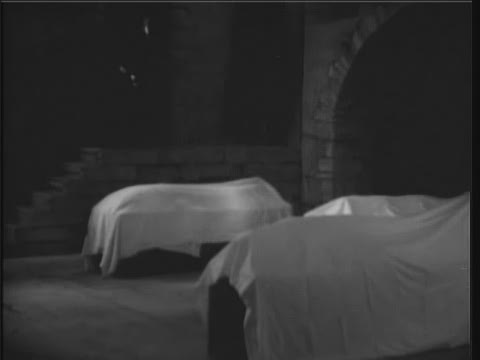
Meirscchultz’s “victim” (if that’s the right word for a dead person who you are trying to bring back to life) is a carbon monoxide suicide, who looks like she might have had rather a lot to live for (but what do we know of another’s inner sorrows?).
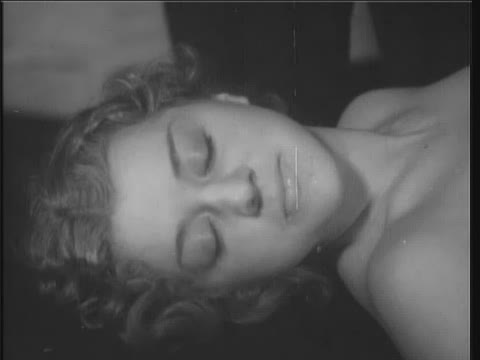
Mad scientist Meirschultz get right to work.
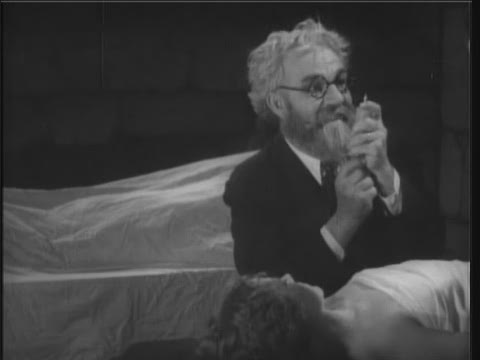
With success!  The victim is revived, sort of, and smuggled back chez Meirschultz to continue her recuperation.

Unfortunately success goes to Dr. Meirschultz’s head, and on his hubris follows nemesis, as it so often does in the mad science movie.  Wishing to continue his experiments, he hands Maxwell a gun and invites Maxwell to shoot himself, so that he can be the next Meirschultz success.  Bad move, Meirschultz.  Maxwell loses his cool and shoots Meirshcultz instead.

Unfortunately Meirschultz is some sort of psychiatrist in addition to being a mad scientist, and when some of Merischultz’s patients show up, Maxwell decides to try impersonating Meirschultz to keep the law away.

This leads to some unfortunate complications when Maxwell gives one of Meirschultz’s already-unstable patients the wrong injection (of “Superadrenaline”), a screwup which generates The One Drug Freakout Scene to Rule them All.  Said patient then abducts the revived dead girl (possibly — the character is played by an entirely different actress).
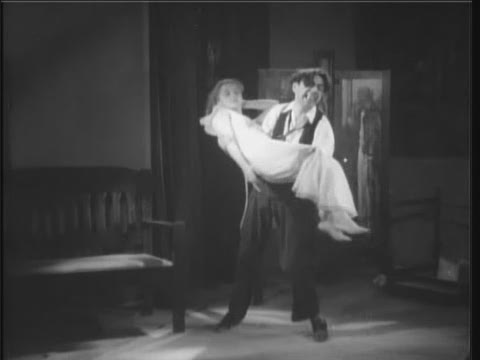
He runs off into the woods with her and tears off her dress, leading to a rare post-Code example of on-screen nudity.

(El Santo is hilarious on just how gratuitous this scene is.)
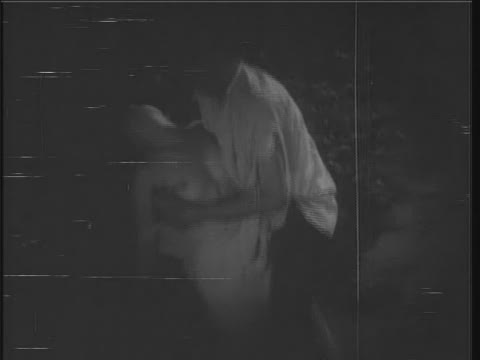
And it only gets stranger from there.  Corpses bricked up in cellars, insane neighbors, more utterly gratuitous scenes of young women lounging around in their undies, bogus “educational” inserts…you cannot miss this one.

Fortunately you don’t have to, because it’s available at the Internet archive.

It’s free, so you can’t ask for your money back.

Update 20111224: I realize that the embedding seemed broken for a long time, but I hope it’s fixed now.

[Faustus May 11, 2018: The embedding apparently broke again, but should now be fixed again, and let’s hope it sticks this time.

Light, more light

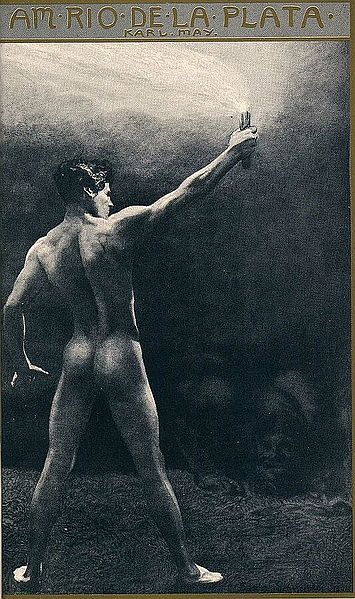
One might criticize EroticMadScience for being a little to much inside the hetero male gaze, and that criticism, I fear, would be sound.  So a little relief therefrom (I hope) following the theme of bringing light to the world, which I explored a bit a few days ago.

An illustration cover to a an 1894 novel by Karl May (1842 – 1912), a very prolific German-language writer, many of whose stories were set in an imagined American West.  May was immensely popular in his day:  his reputation is done a grave injustice by the fact that Adolph Hitler liked his books (which, as far as I know, provide no support for Nazi doctrines — note that Albert Einstein was also a major fan of May).  I haven’t been able to find much about this particular cover, although there is some interesting French-language commentary on its homoerotic implications here [Faustus May 11, 2018. I can no longer find the original post, but the blog of which it was a part is preserved in the Internet Archive].

Bringing light to the world

Looking for the appropriate link about Jules Joseph Lefebvre for yesterday’s post brought my eye to this lovely image, which I thought worthy of a digression.

La Vérité (Truth) the original of which hangs in the Musée d’Orsay in Paris.  The Wikipedia caption notes  “The painting is contemporary with the first small scale model made by Lefebvre’s fellow-Frenchman Frédéric Bartholdi for what became the Statue of Liberty, striking a similar pose, though fully clothed.”

Great Cthulhu, thinks I.  If only they had used Lefebvre’s version for what now stands in New York Harbor, instead of the severe and heavily-draped figure created by Bartholdi!  I for one would be so much more patriotic.  (Maybe it’s a bit late but if you’re a U.S. citizen and want to write your congressman and protest the choice, you can use this form.)

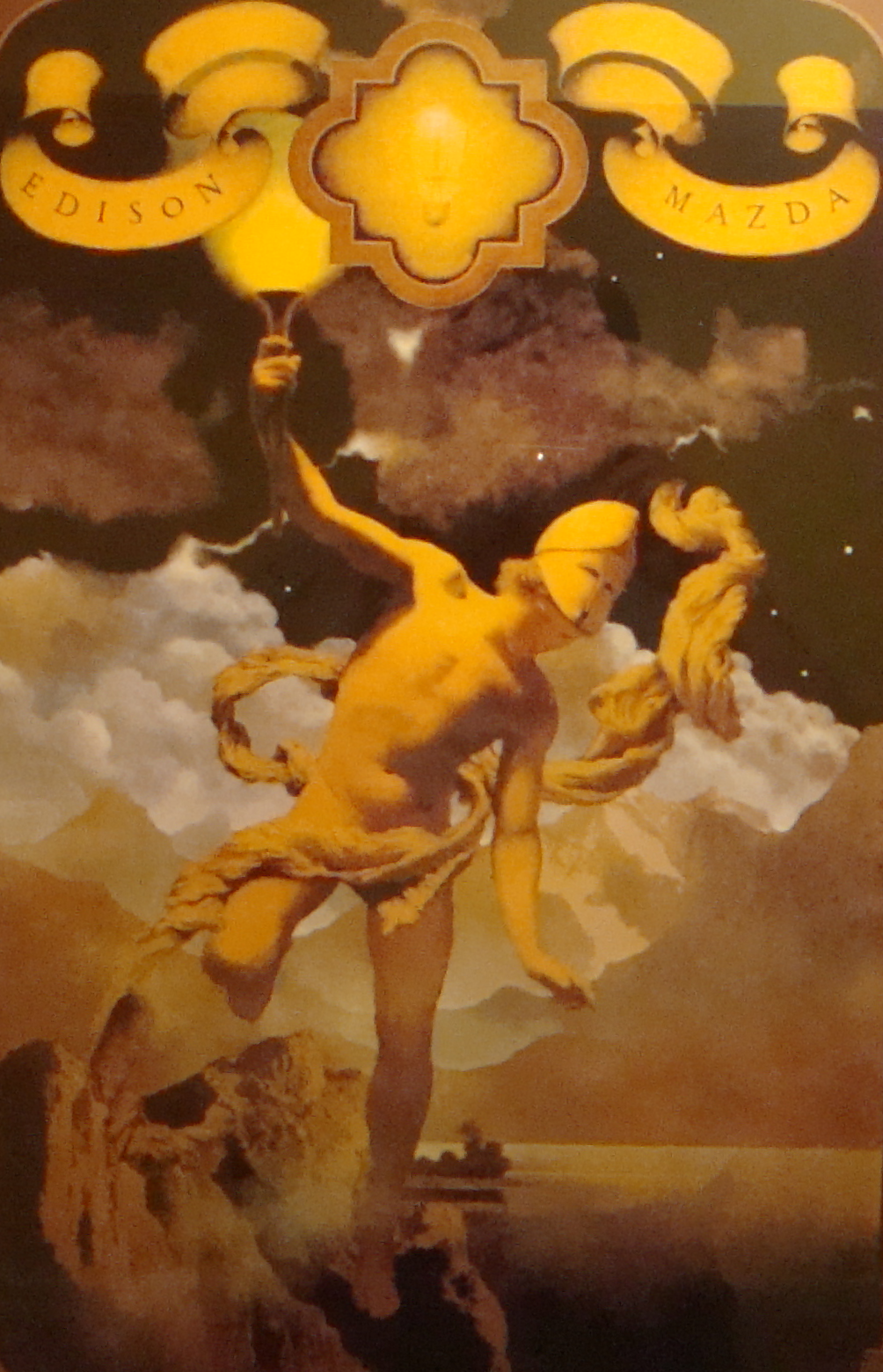
All well and good, but any link to Erotic Mad Science, except the bloggage?  Well, I suspect there is a connection to patron divinity Prometheus, anyway, through this piece of artwork created by Maxfield Parrish.  I for one suspect a visual influence:

Prometheus bringing light to the world.  In the form of light bulbs made by Edison Mazda, it would seem.  A reproduction hangs right outside my study.  Honest.

The Wasp Woman

One book I was assigned in my freshman English class in college was the then-current edition of The Norton Anthology of  Poetry, the editors of which, doubtless attempting to appear hip to an audience of jaded 18 year-olds like my then-self, chose to include among the works of Shakespeare and Keats and Emily Dickinson a work by one Lawrence Raab entitled “Attack of the Crab Monsters,” which ended with the immortal lines

Sweetheart, put down your flamethrower. You know I always loved you.
Perhaps not “Shall I compare thee to a summer’s day?” or even “My Life has stood – a Loaded Gun – “, (or even “They fuck you up, your mum and dad”) but it will do.  What I didn’t realize at the time was that this was a homage of sorts to to one of the greatest non-great producers and directors of all time, to wit one Roger Corman, who in fact did create Attack of the Crab Monsters.

Now perhaps Corman has a reputation as something of a schlockmeister, but if so he was a sclockmeister with a difference.  He had an eye for talent and that combined with a directorial imperative of tell a story cheaply and keep the audience entertained made him into the world’s greatest One-Man Film School:  Francis Ford Coppola, Martin Scorsese, and Jonathan Demme all pretty much got started out by Corman, and that alone would probably be enough to earn him immortality among filmmakers.

But beyond that, Corman made some surprisingly intriguing movies for the thaumatophile.  One which deserves some serious attention here would be The Wasp Woman (1959),  which stands as a sort of ancestress to Invasion of the Bee Girls,  which as readers of the Thamatophile Manifesto know, is a key influence for Dr. Faustus.  And it’s certainly a subject worth revisiting here, for that reason and also for some others as well, such as the fact that at least one woman’s intimate encounter with a giant member of arthropod persuasion and subsequent…changes…plays an important part in the developing Gnosis plotline.

The core plot of The Wasp Women is easy to summarize.  Entrepreneur and model Janice Starlin (played by Susan Cabot) runs what has hitherto been a successful cosmetics business, trading on her own glamorous image.  But 40-year old Starlin’s fears that her looks are fading, so she stops appearing as the spokesmodel for her own business, with terrible financial results.   Not to despair, though, as rather mild-mannered mad scientist named Zinthrop happens in with a supposed way to reverse aging, using the “royal jelly” of wasps.  Starlin leaps at the chance, giving Zinthrop his own laboratory and putting him to work developing what she hopes will be not just a way of reversing her own aging, but also a way of creating what will surely be an absolutely unbeatable product.   Overriding Zinthrop’s objections, she even insists on making herself the first human test subject, even going behind Zinthrop’s back to up her dosage of the miracle substance when it isn’t working as fast as she would like.

And what do you know?  The mad science thing works.  There’s just one little side effect…

Now as reviewer El Santo points out, this plot inverts a standard mad science narrative.  In that narrative, the insane/evil/overreaching mad scientist abducts or suborns a pretty girl and makes use of her as an experimental subject, until perhaps she is rescued by the hero.  It’s a variant of the brave knight rescuing the fair maiden from the evil dragon/ogre or what have you.  But the plot of The Wasp Woman is really about female protagonism.  It’s Janet Starlin who pushes hard for the mad science:  the mild-mannered but eccentric Zintrhop here is more the voice of conservatism and caution than anything else.  Starlin is the one who desires to be the subject of the experiment, and she jumps in with both feet.

El Santo reads this as a part of a bit of subtle (and subversive) commentary on gender relations in the 1950s:  women weren’t taken seriously in their own right and had to trade on their youthful looks, so Janice Starlin had an intelligible motive in pushing things along so desparately.  I think El Santo’s point is correct, but the focus of my attention is elsewhere.

Let me put it this way:  why is this movie the subject of a post at EroticMadScience.com?  It’s pretty buttoned-up 1950s.  No nudity.  No sex.  The answer is this:  I find an amazing turn on in subject protagonsim in mad science.  I do not know exactly why this is, but Nanetta Rector’s bold and unsolicited demand “Make me a liquid girl” or Maureen Creel’s taking a deep breath and turning on the invisibility machine or Aloysius Kim’s “Death or glory here I come” are real payoff moments for me.  So when Janice Starlin inists that she will be Zinthrop’s first test subject, it’s also a special moment in a special movie.

And thanks to the glories of the Internet, you can see for yourself for free, if you’re so inclined.  A magnificent resource called the Internet Archive is making available a lot of old movies for free streaming and downloading, and The Wasp Woman is among them.  I’ve embedded it in the post below, but if that doesn’t work (it’s fussy with some browsers), you can always visit the relevant Internet Archive page here.

Enjoy!

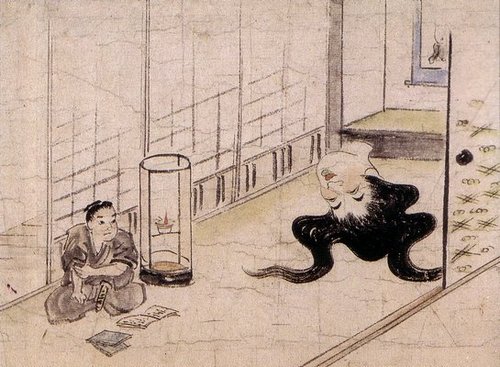
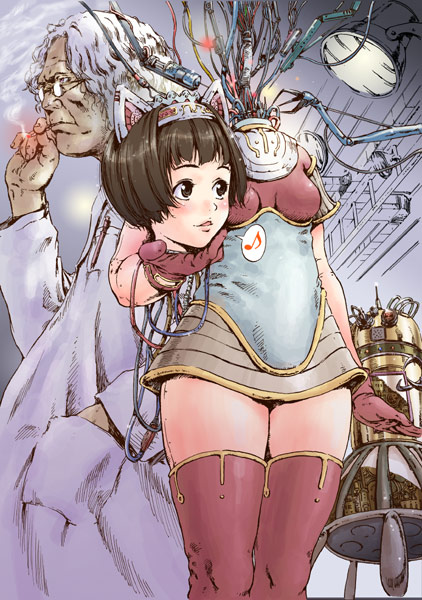
Detached heads

There is an additional detached-heads visual tradition, and it appears to be Japanese.  Three images are all via Janitor of Lunacy, but I don’t know much more about their specific provenance.  (If anyone could offer any in comments I would be appreciative.)  The first has the look of a traditional ukiyo-e.

The next is much more in an anime style. It’s the most thaumatophile of the bunch, what with all those wires and a pretty Rotwang-like figure in the background.  Since the main character is a robot, it’s perhaps not surprising that she can be insouciant about the fact that she’s carrying her own head.

And the last falls into the category of “I really am at something of a loss to explain what’s going on here.”  But I include it because (among other reasons) the visual look of the rings which divide head from body here is the closest image I’ve found to the hyperspatial cinctures in Where Am I?

Like I wrote, if anyone could contribute any understanding here…

Mad science essential: Re-Animator

I started writing this post because I was pondering Dolly Gibson’s misadventures in Where Am I? and wondering about possible inspirations for a storyline in which a head is separated non-fatally from a body.  Something did come up, and I hope it’s of interest, but I have to get there with a bit of a digression.

Now normally decapitation is a means of death, is indeed almost symbolic of death most inescapable.  And death means the end:  in Hamlet’s fictional universe it is the undiscover’d country from whose bourn no traveller returns.  But in mad science, and therefore in the Gnosis universe, death has become something more of an exotic tourist destination, as Iris Brockman herself could tell you from lived (?) experience.

And that’s no coincidence.  Dead matter turned living is a core topos of mad science.   We can go all the way back to Ovid‘s Metamorphoses for the appropriate inspiration if we like.

Sanctius his animal mentisque capacius altae
deerat adhuc et quod dominari in cetera posset:
natus homo est, sive hunc divino semine fecit
ille opifex rerum, mundi melioris origo,
sive recens tellus seductaque nuper ab alto
aethere cognati retinebat semina caeli.
quam satus Iapeto, mixtam pluvialibus undis,
finxit in effigiem moderantum cuncta deorum,
pronaque cum spectent animalia cetera terram,
os homini sublime dedit caelumque videre
iussit et erectos ad sidera tollere vultus:
sic, modo quae fuerat rudis et sine imagine, tellus
induit ignotas hominum conversa figuras.

I’m not as good at Latin as I really ought to be, so I’ll rely on A.S. Kline‘s prose translation:

As yet there was no animal capable of higher thought that could be ruler of all the rest. Then Humankind was born. Either the creator god, source of a better world, seeded it from the divine, or the newborn earth just drawn from the highest heavens still contained fragments related to the skies, so that Prometheus, blending them with streams of rain, molded them into an image of the all-controlling gods. While other animals look downwards at the ground, he gave human beings an upturned aspect, commanding them to look towards the skies, and, upright, raise their face to the stars. So the earth, that had been, a moment ago, uncarved and imageless, changed and assumed the unknown shapes of human beings.

Prometheus takes dead matter and makes it living, in forms that resemble the very gods themselves.

And unsurprisingly, when Mary Shelley writes Frankenstein, (Project Gutenberg text here) the locus classicus of mad science, she will subtitle it The Modern Prometheus. Once-dead matter becomes living.

And then when H.P. Lovecraft choses to parody Frankenstein, he will create a story called “Herbert West–Reanimator,” (Wikisource text here), in which the mad science gets even madder, and in which of course a decapitation features prominently and then, of course…

…exploitation filmmakers get hold of the concept and push it still further, resulting in an extraordinary mad science movie.

Dead matter becomes living in an amazing way.  And of course, there is a head in a dish on a desk.

But that’s not all.  While Ovid is lofty mythology and Mary Shelley is high literature and even Lovecraft writing a story that seems full of his own neuroses (his story contains racist elements that really burn, I’ll have you know), kickass filmmaker Stuart Gordon is clearly going in his own direction here — a direction that brings the whole dead-matter-is-living and decapitation-is-not-the-end thing right into Dr. Faustus territory with what tireless reviewer El Santo identifies as “what could be the most disturbingly vile sexploitation-horror set-piece of its era.”

Yes.  And it wouldn’t be EroticMadScience if we didn’t dwell on that a little, at least below the fold.

Continue reading

Bursting out

Bert I. Gordon (look at the initials) is best remembered, perhaps, as the creator of movies like The Amazing Colossal Man (1957), but he also gives us at least one decent thaumatophile moment in what is otherwise a real stinker of a movie called Village of the Giants (1965).

The movie does feature a Mad Scientist of sorts — an annoying Boy Genius imaginatively called “Genius.” He invents some sort of wonder substance that causes biological organisms to grow to colossal size (a theme dear to B.I.G.’s heart, obviously).  A crew of dim, overaged teenagers steal of of the substance and camp out in an abandoned theater, and consume some.

And while this movie is stupid on all sorts of levels (it was riffed on but good by the MST3K crew), B.I.G. does manage to get one thing right, which is that he takes account of the fact that a wonder substance that blows you up to several times your natural size won’t necessarily blow up the clothes you are wearing, and that’s a result that B.I.G. rightly exploits for some decent sexploitation, at least for 1965.

I’ve done part of the result as animated GIFs for your edification.  Since they’re sort of big (hmm…) and since some people find them annoying I’ve tucked them beneath the fold.  Click at your own risk!

Continue reading

Teen-age sweetheart of the 21st century

After all the Sturm and Drang with which Gnosis Dreamscapes ends up, I thought it might be nice to come up with a little something bright and cheerful for all of you to start your workweeks.

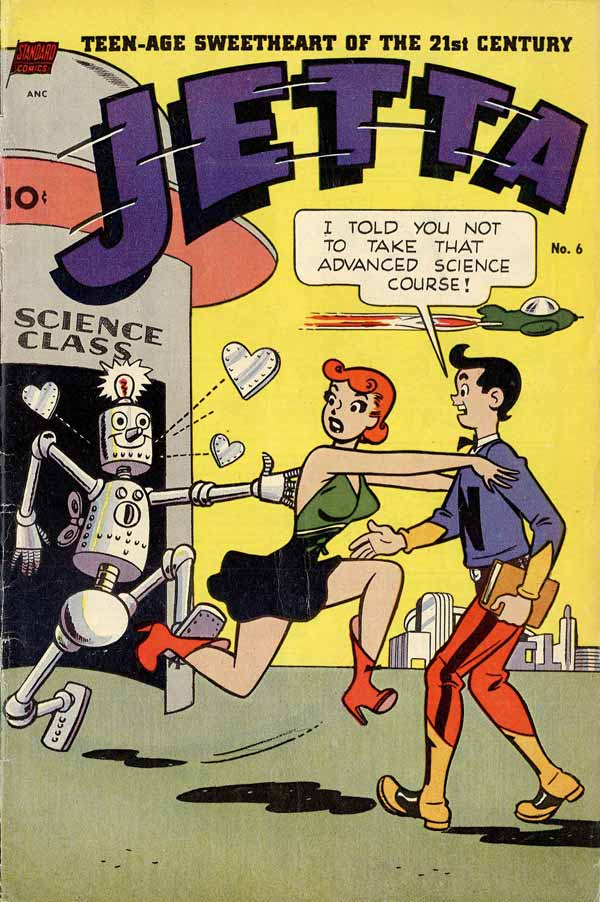
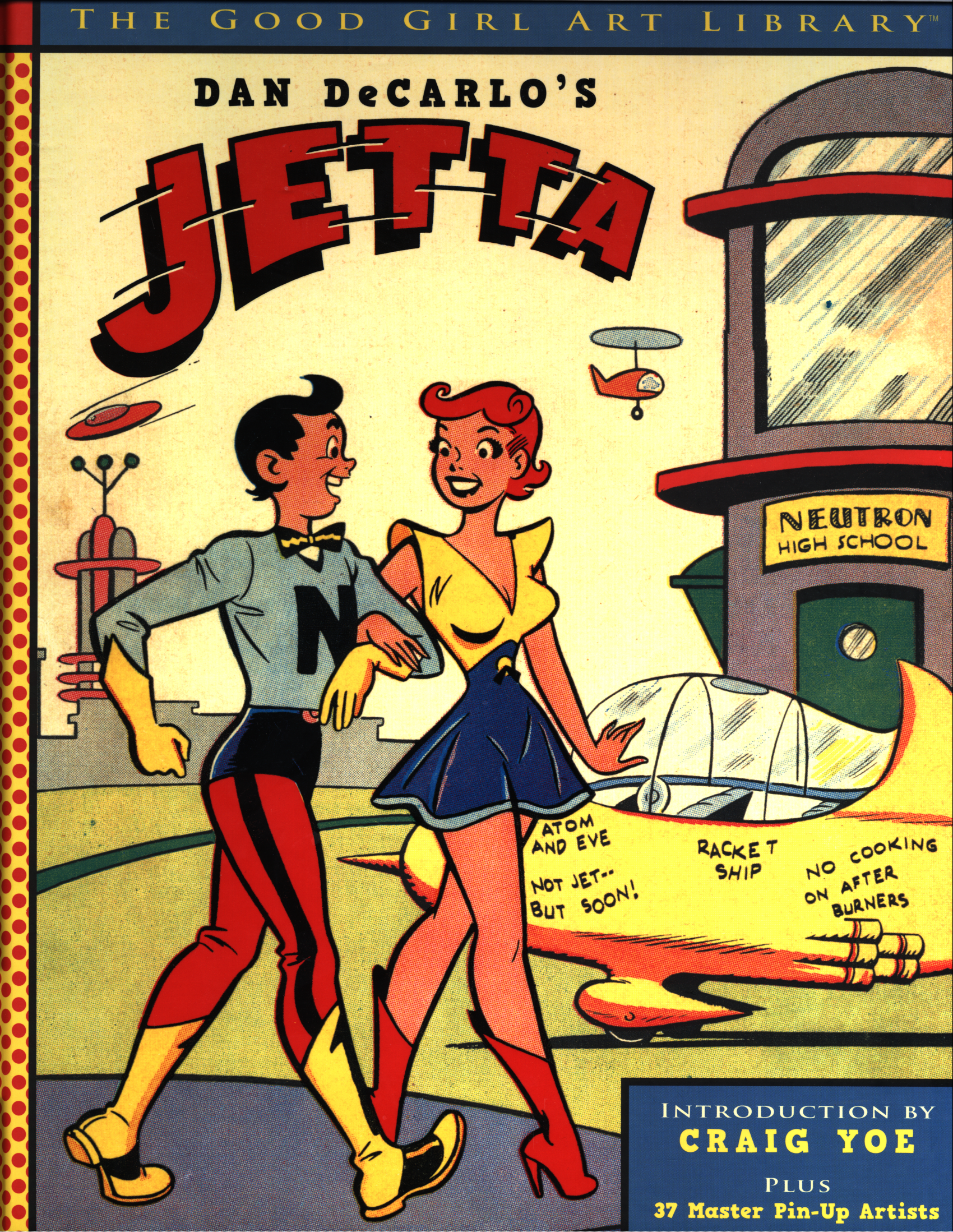
A few years ago, James Lileks as part of a series called “Funny Books:  Dubious Moments in Comics History,” featured the following cover from a short-lived early 1950s series…

…together with some appropriate (and funny) snark.   Naturally, when I first saw it, I wanted to see more of this curvaceous redhead in her natural habitat. The illustration alone would have been appealing enough, and the artist Dan DeCarlo — probably best known for his work on Archie — was one of talent.

But what to do?  This was a very minor comic book written over half a century ago (and a pain to Google, too, since a certain car made by Volkswagen will swamp your attempt to do so).

But we live in a happy age, we do.  Back in the 1970s a critic named Roger Price formulated something he called Price’s First Law, a dismal reflection on consumption in a mass-production age:  “If everybody doesn’t want it, then nobody gets it.”  But now in the era of the long tail, a new principle has taken hold (let’s not call it Faustus’s Law, please):  “If anybody every loved it, then everyone can get it.”

And so with Jetta.  We are blessed to have among us one Craig Yoe, comix historian extraordinary.  You might be familiar with him as the compiler of Clean Cartoonists’ Dirty Drawings or perhaps Secret Identity:  The Fetish Art of Superman’s Co-Creator Joe Shuster.  (And if you’re not, you owe it to yourself to have a look-in at the steamy, seamy demimonde of comix art — it’s fun!)

As it turns out, Yoe has a recent project of some interest:

Ta da! Every issue of Jetta ever to be published, right in an appealing hardbound edition.  The long tail wins again!

Now perhaps one might think that Jetta is a marginal topic for EroticMadScience.  Eroticism is rationed strictly in the form of winking, nudging cheesecake (this was a book thought fit for sale to minors in the 1950s).  And the science isn’t too mad.  It’s more like a goofy imagined future, full of jet packs and flying cars and clunky robot servants in a brightly colored populuxe built environment.  But personally, I think that’s appealing.  YMMV, dear readers.

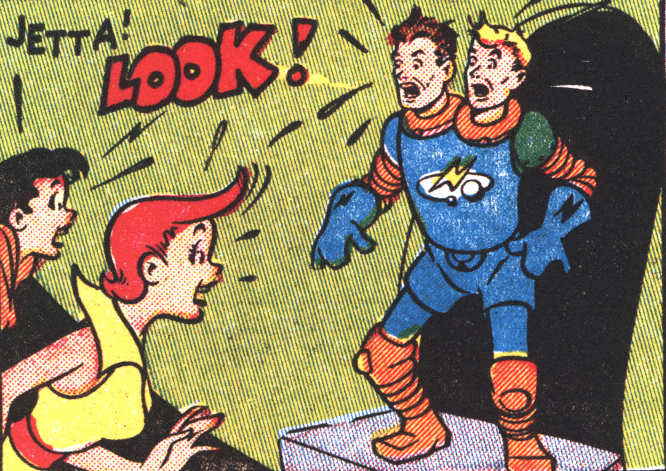
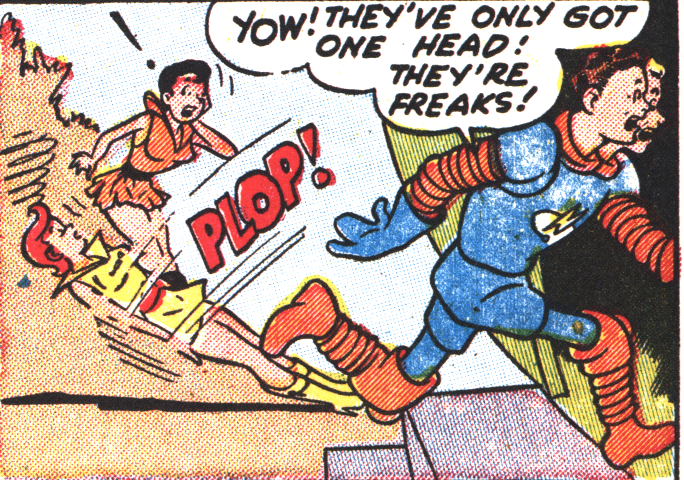
Maybe there’s a little hint of conjoinment in one episode, and thus a tenuous link between Jetta’s innocent future past and my rather kinky present.

But even if DeCarlo’s teen-comedy romp isn’t your particular cup of mad-science mystery formula, there’s another virtue of Yoe’s collection:  39 pinup artists who’ve re-imagined Jetta for our age.  I’ll provide some examples of — thumbnails only, as these are working artists who deserve patronage.  You can click through to the websites if you’re interested.

Jetta (right) as envisioned as a pure pin-up girl by artist Ben Tan.

A humorous take (left) done by comix artist Colleen Coover.

And additional, rather sexy take (below), done by Bill Presing.  Looks like the robot won out after all!

Plus 36 more if you pony up for the book itself, and original DeCarlo pinup art to boot.  See Veronica Lodge just a smidge hotter than you probably ever have, with perhaps one exception

Moar Kanai

Having brought up Kiyoaki Kanai as a visual inspiration for a pirates post a few days back, I would feel remiss if I did not at least note, before returning to the main thread of posts on Gnosis Dreamscapes that Kanai has some work that can be much appreciated by thaumatophiles. The images to the left and below (those below you can click through for larger) are prime examples.  As usual I don’t read Japanese, and running the accompanying text on the pages  through Google translate tends to leave me feeling even more befuddled than before.  Your tastes may vary, but statements like “So, I accidentally forgot the appeal of humanoid robot was there, I became a robot servant of his sex slave robot and robot body instead of a relative…the human mind, remedies or the mind, the need for further development of the robot to go towards a better feel in your area” tend to leave me scratching my head.  (Although sometimes the pictures do lead to a better feel in my area, I must admit.)   But I think it’s pretty clear that the images to the left and immediately below suggest the manufacture of female sex robots, combined with extensive testing thereof.   Shades of Robotrix!  Perhaps we’re looking at the Consumers Union laboratory of the near future?

And Kanai, naturally, also did his own rather complex take on the important theme of the sex machine.

That’s something dear to our hearts here!

Traveling by tube bleg

On the theme of traveling by (liquid-filled) tube, I have an image to share, courtesy of my friend Bacchus:

It clearly fits into the visual inspiration of the “traveling by tube” post, also seems to fit into the visual aesthetic of Professor Corwin’s Apsinthion device.  (Hard not to think of Anwei, no?) But sadly, neither of us knows much abou the image’s actual provenance.  I for one would dearly love to know, so if you do, please do comment!