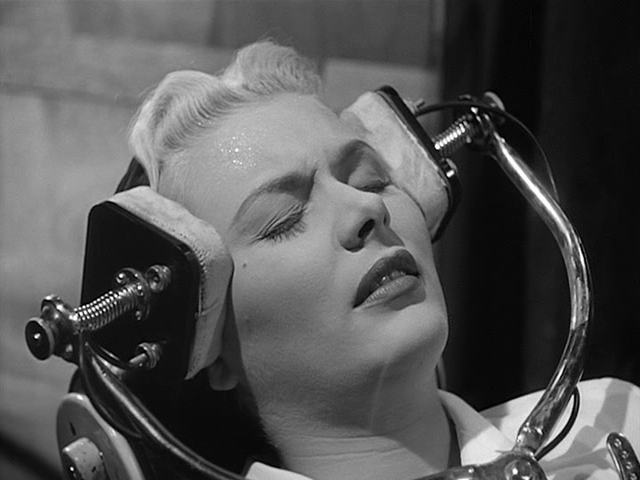
Last week’s new Apisinthion Protocol art and the recent post on Altered States got me inspired to go looking for some additional melting girl art and look, I found me some. One example:
You know, maybe TV is better in other countries. The German television program Liebe Sünde(literally “Love Sin”) which broadcasts on the VOX channel provides us with an example of a live action tube girl, which is rare but not unknown. One screencap:
The weakness of human memory means you’re often surprised when re-encountering your influences.
I saw Ken Russell‘s movie Altered States(1980) sometime when I was in high school, I think by passing myself off as a student at a local college and attending one of its film society’s screenings (I did that a lot — it made adolescence vastly more bearable). And I recalled thinking at the the time that it was weird and sort of interesting and then largely forgot about it at least consciously.
Just this weekend I re-watched for the first time and realized that it must have lodged a lot more deeply in my subconscious than my conscious mind.
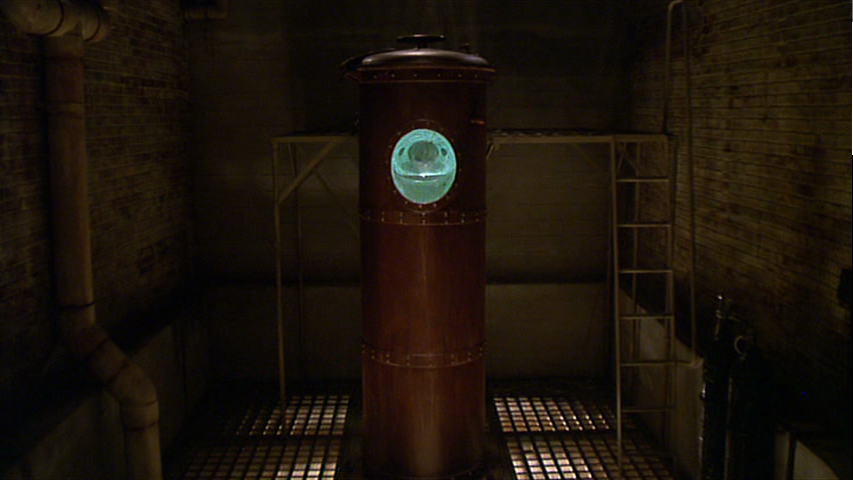
William Hurt played a psychology professor named Edward Jessop who was obsessed with the idea of finding deep secrets from the human evolutionary past — perhaps the universe’s entire past — buried within the self. He thought he could do this by inducing various altered states of consciousness. One of his initial techniques involved the use of sensory deprivation tanks, which meant a real mad-science setting. His initial experiments were with student volunteers, and then he began trying out the apparatus himself.
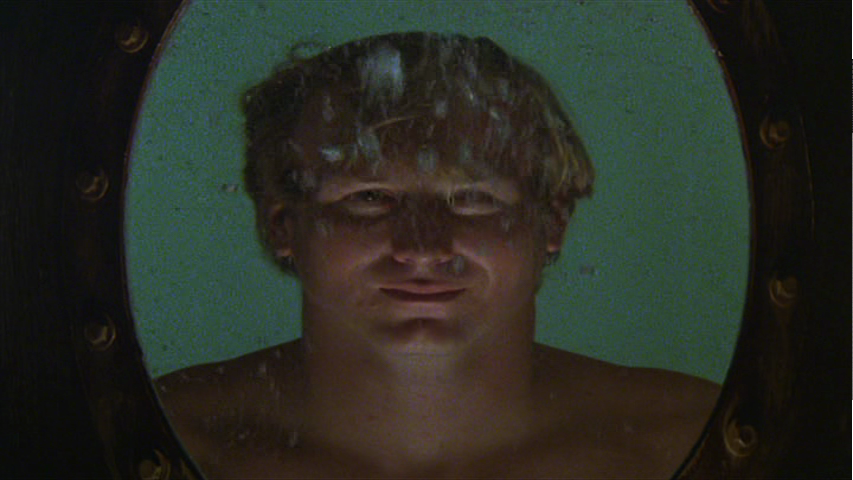
A psychology professor who’s something of a mad scientist who experiments on his students using a fluid-filled tube. Looks like that was something that would be popping back out of my own consciousness later on. In addition, we get to see an example of William Hurt as a tube guy.
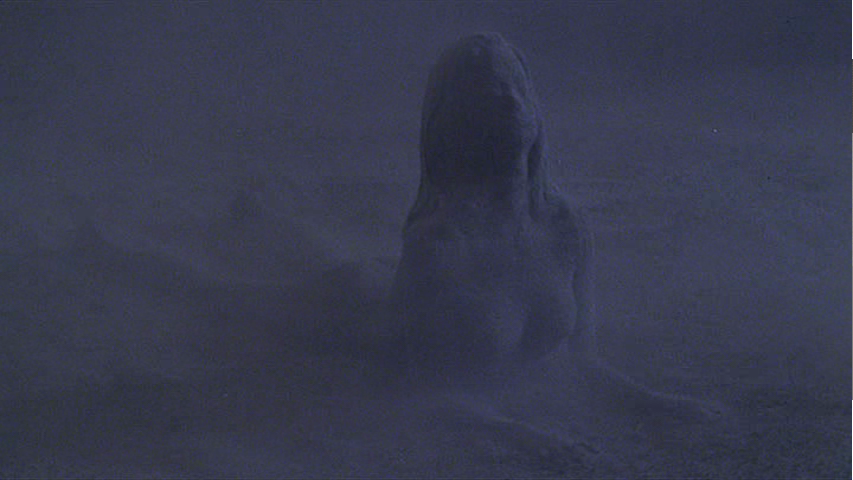
Later on Jessop will travel into central Mexico and experiment with hallucinogenic mushrooms. He has an erotic vision of his wife Emily, played lusciously by Blair Brown.
In the course of the vision “Emily” is covered by some sort of blowing sand or dust, which gives an A.S.F.R. feeling to the whole vision.
That’s something that wouldreturn to my erotic consciousness later on.
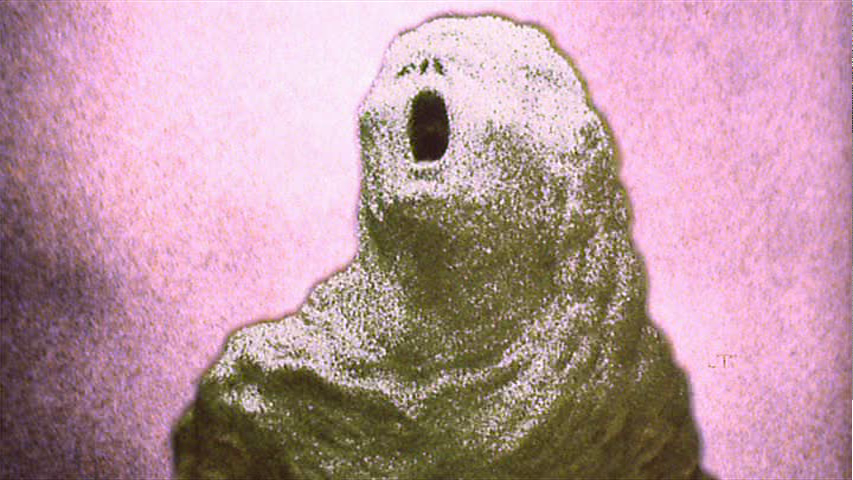
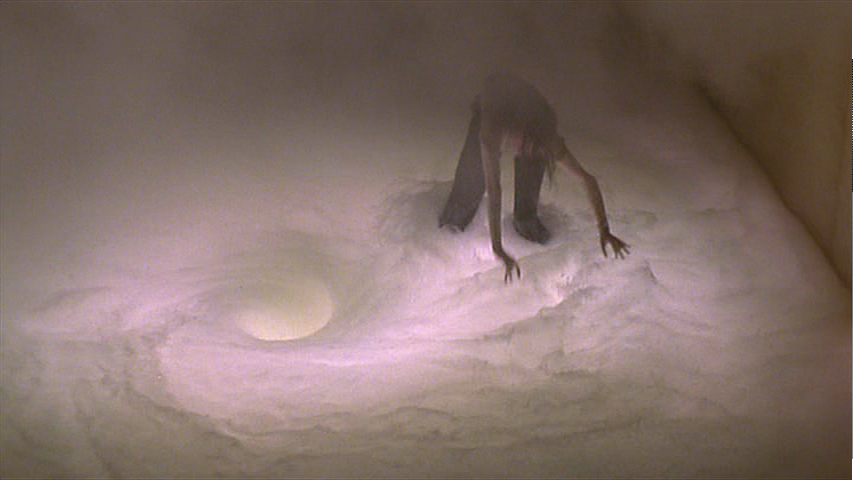
Putting the magic mushroom juice together with the isolation tank produces very strange results — a man who begins dissolving into something like primal protoplasm:
And eventually into a swirling vortex of liquid, before being reconstituted into his normal self, or at least, as normal as his self ever really gets.
I could probably go on mining this movie for plenty more if I really wanted to try to decode all its drug imagery (I can’t help but note that crucifixions are common). But for now I’ll just leave with a bit of dialog that left me drop-jawed. It’s Emily early in the movie, talking to Jessop.
emily
You don’t have to tell me how weird you are. I know how weird you are. I’m the girl you bedded the past two months. Even sex is a mystical experience for you. You carry on like a flagellant which can be very nice but I sometimes if it’s me that’s being made love to. I feel like being harpooned by some raging monk in the act of receiving God. And you are a Faust freak, Eddie. You’d sell your soul to get the Great Truth.
And she’s delivering this remarkable speech in the course of proposing to Jessop that he marry her. Talk about a girl willing to jump in with both feet!
You might recall a warning from a few days ago that when you go fetish fuel mining in old pop culture you might get a bit dirty. That’s sort of how I feel about today’s post, but somehow I can’t resist the underlying material all the same.
The character of Fu Manchu is one of the earlier characters one might call a supervillain. He was created in 1913 by the English novelist Sax Rohmer (1883-1959), and he must have scared the willies out of contemporary audiences as the embodiment of some rather deep fears. As Rohmer’s protagonist Nayland Smith described him in The Mystery of Dr. Fu-Manchu:
Imagine a person, tall, lean, and feline, high-shouldered, with a brow like Shakespeare and a face like Satan, a close-shaven skull, and long, magnetic eyes of the true cat-green. Invest him with all the cruel cunning of an entire Eastern race, accumulated in one giant intellect, with all the resources, if you will, of a wealthy government—which, however, already has denied all knowledge of his existence. Imagine that awful being, and you have a mental picture of Dr. Fu-Manchu, the yellow peril incarnate in one man.
Yes, I’ll agree that racism really burns here — a topic I’ll be returning to shortly, I promise. But for the moment, I’d like to focus on Fu Manchu as an early cinematic erotic mad scientist. Obviously, here was a subject that Hollywood could not resist.
The instance I have in mind here is The Mask of Fu Manchu (1932). The plot revolves around the struggle between a group of British archaeologists and Fu Manchu over possession of a mask and scimitar that supposedly belonged to Genghis Khan. Fu Manchu believes that with them he can be recognized as the new Genghis Khan and rouse the masses of Asia to rise up and wipe out the white people of the world. Because of course everyone in Asia can instantly recognize centuries-lost artifacts as genuine on sight, right? Hey, I didn’t say the plot had to make any sense. What I’m here for is the erotic mad science.
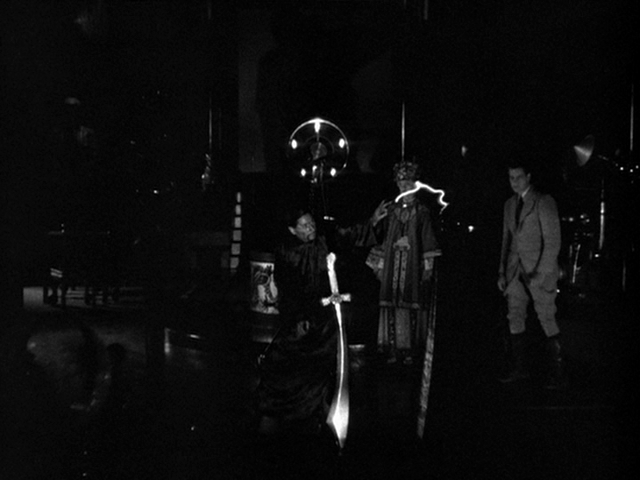
Which we get in satisfying doses, this being a pre-Code production. Fu Manchu is in fact an accomplished scientist, possessing at doctorates in “philosophy from Edinburgh, law from Oxford, and medicine from Harvard.” (In spite of this, not a single white character in the movie addresses him as “Dr. Fu Manchu.” That’s a jerk move on their part. I’ll take the opposite tack and pay him the respect one man of learning owes another and include his honorific for the rest of the post.) He’s played by Boris Karloff, who, while he doesn’t look noticeably Chinese, at least can be said to have appeared on this site before. Also, he gets the mad science thing going good, testing a candidate scimitar with the power of SCIENCE.
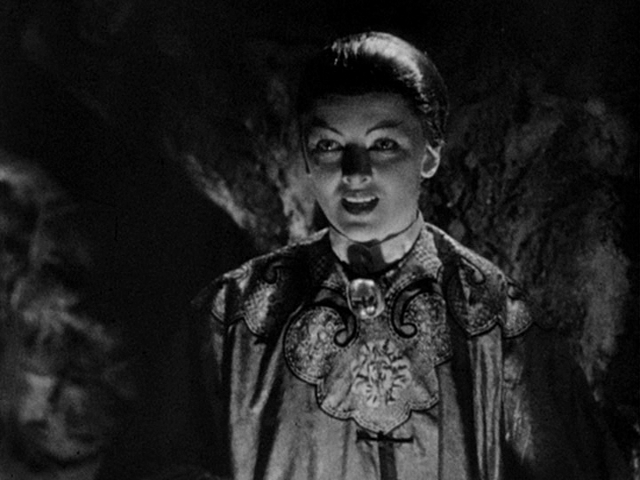
And Dr. Fu Manchu also has a daughter, Fah Lo See, played by Myrna Loy, who’s also not noticeably Chinese, but at least is fun to watch. Especially when she’s supervising the flogging of one of the English guys, which I must say, she really gets off on.
You’re a long way from Nora Charles here, Miss Loy. There’s a single YouTube clip which shows both exciting events, which I’ll attempt embedding here.
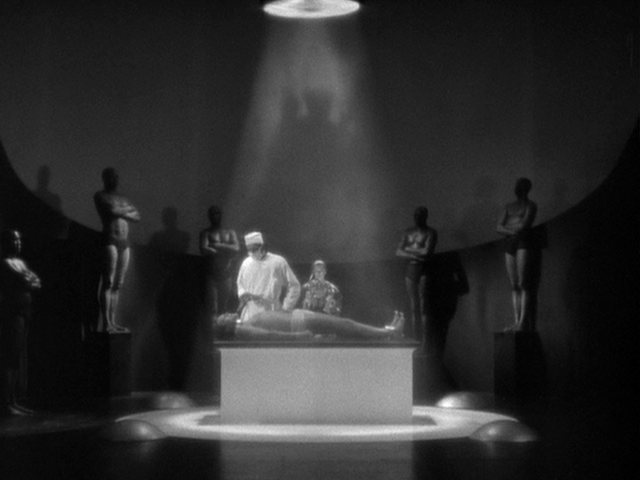
We also get to see Dr. Fu Manchu show off his surgical skills when he injects flogging-guy with a mind control drug. I’ve seen a commenter who identifies the scene in which it happens as “the most homoerotic surgery scene I’ve ever seen.” I must say I’m hard-pressed to disagree.
The guys standing around in short-shorts are big-muscled African men. Since the action for this film is set deep in the interior of China in 1930s, I’m not really sure exactly how Dr. Fu Manchu managed to recruit them. Perhaps there was some sort of special agency for that. I’m also not sure why they have to stand around like that, although they sure look cool doing it.
So anyway things spiral downward for the British Empire as Dr. Fu Manchu manages to capture the pretty blond (of course) girlfriend of our hero and set her up for a blood sacrifice (of course).
Would you all have maidens like this for your wives?
(pauses while the assembled crowd roars approval)
Then conquer and breed! Kill the white man and take his women!
Well, naturally we can’t have that now, so Nayland Smith escapes from the overly-elaborate, easily-escapable deathtrap which the genius but not-genre-savvy Dr. Fu Manchu has placed him in and saves the day.
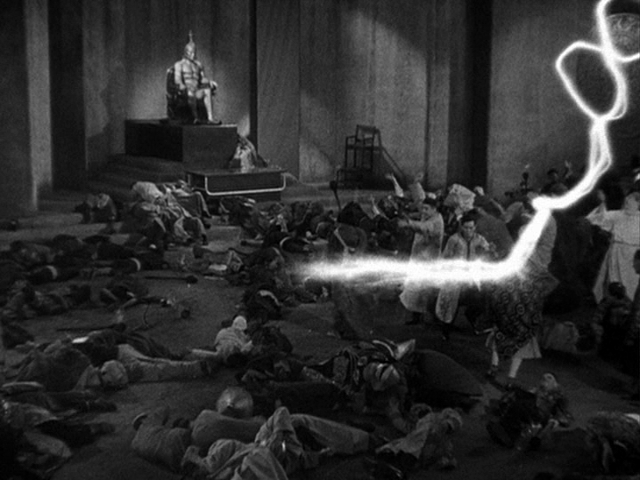
By using an energy weapon created by Dr. Fu Manchu to massacre a lot of Asian men who haven’t really done anything. We sure know where this movie’s value system is.
Yeah. Dirty, and not in a good way.
But of course, the awfulness can’t really stop there. There’s a concluding scene on a ship back to England, in which Nayland Smith has a conversation with a steward who’s just arrived to inform everyone that dinner has been served.
nayland smith
Good evening.
steward
(in an affected “Chinese” accent)
Good evening, sir.
nayland Smith
You aren’t by any chance a doctor of philosophy.
The Steward laughs and shakes his head in negation.
nayland smith
Law?
The steward shakes his head again.
nayland smith
Medicine?
steward
I don’t think so, sir.
nayland smith
But are you sure?
steward
Oooh yes. Very sure.
(laughs again)
nayland smith
(shaking the Steward’s hand)
Then I congratulate you.
steward
Thank you.
(walks off, banging a gong and calling out)
Dinner is served!
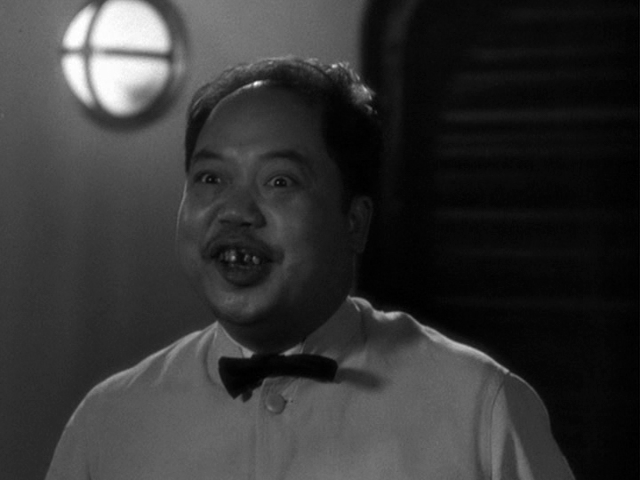
Yeah, yeah. I get the point the filmmakers clearly wanted to make here. Educated and competent Asian: bad. Servile and comical Asian: good. And if you don’t believe me, take a look at the steward himself.
Do you think that there were no Asian actors in 1932 with decent dentition available, or was this some sort of casting choice meant to drive home a certain point?
You know, I’m beginning to sympathize with Dr. Fu Manchu’s point of view. If I had to live in a world full of people who took this who think my role in life is to be servile and hold my life cheap because of my ethnicity, I’d be seriously pissed off as well. I wouldn’t go for genocide (I think — just how attractive are the enemy’s women again?), but a delivering a serious collective ass-kicking would be a formidable temptation. Evidence, perhaps, of Dr. Fu Manchu as a mad scientist motivated at least some by woundedness.
I don’t doubt that many, perhaps most, readers of Erotic Mad Science have at some point seen Tim Burton‘s The Nightmare Before Christmas(1993). And those of you who have seen it would be surely not forget Sally, an animated ragdoll created by Halloweentown’s resident mad scientist (though perhaps in context he isn’t so mad) Dr. Finklestein. She served as a love interest for the main protagonist and, I must say, I can think of no other cinematic character who makes stalking like quite so adorable.
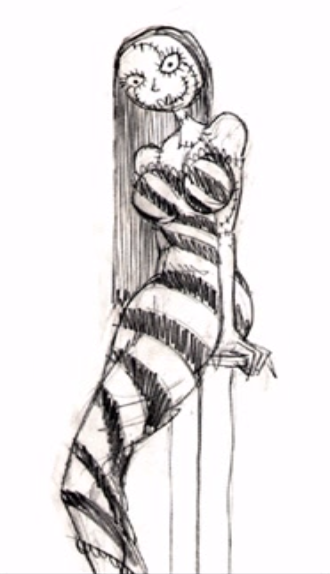
Now in the context of the actual movie, Sally seems to serve Dr. Finklestein as a sort of combination ersatz daughter/houseservant. But I recently discovered a concept art sketch of Sally…
…and that suggests that perhaps creators had some rather other ideas about the reason why Finklestein might have created Sally. Guess that old erotic mad science really is everywhere.
An additional thought: when Sally doesn’t work out as planned for Dr. Finklestein, he creates a new woman, whom he animates by removing half his brain and donating it to her. “Think of the brilliant conversations we’ll have!” Hmm. This act rather reminds me of something. I wonder if Derek Parfit was serving as a consultant to Tim Burton…
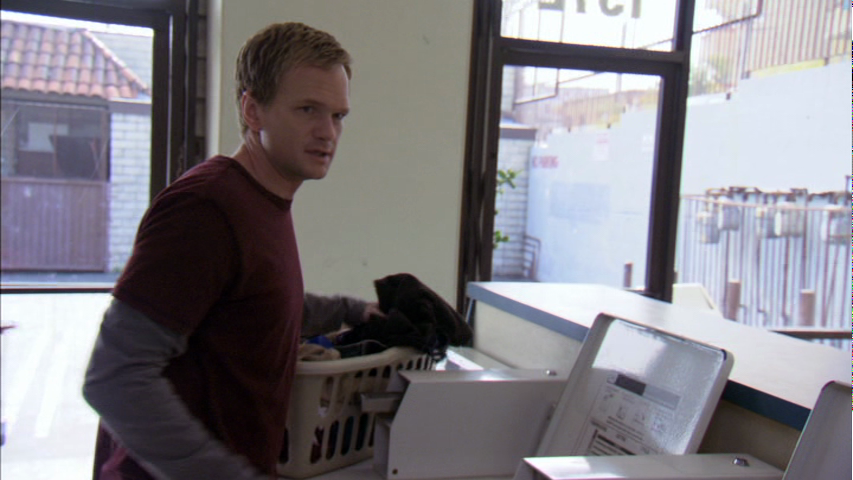
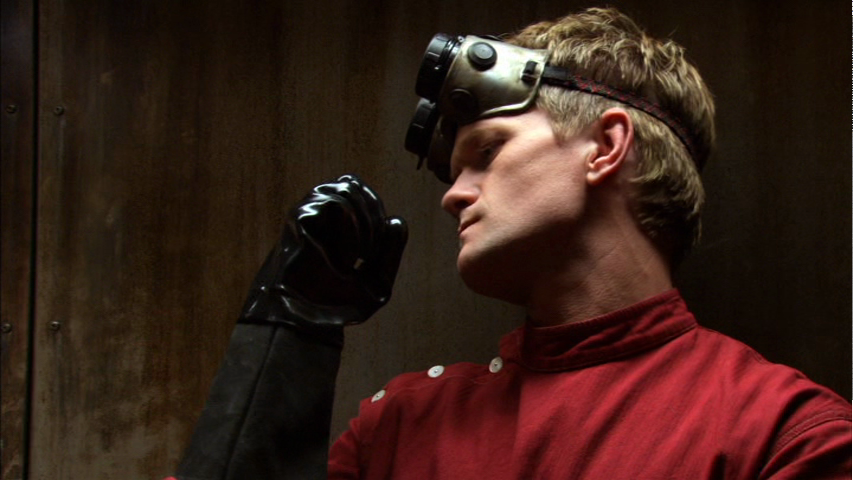
It’s perhaps inevitable that I’d be posting on Joss Whedon‘s freaking awesome musicalDr. Horrible’s Sing-Along Blog, so here we go. Neil Patrick Harris plays Billy/Dr. Horrible, a mad scientist who aspires to join the Evil League of Evil. Also to work up the courage to ask out the cute girl he keeps seeing at the laundromat. He is opposed by his nemesis Captain Hammer, played by Nathan Fillion from Firefly (and who appears here to be having the time of his life hamming it up in this production).
I won’t try to summarize the story much (a detailed summary can be found here), but there’s all kinds of awesome going on, even when Neil Patrick Harris isn’t singing. On my own preferred interpretation (obviously not the only possible one) the story is a mad scientist’s Bildungsroman where Dr. Horrible goes from something like this:
To this:
Awesome. Plus he has an evil laugh, a time-freezing ray, a death ray, and a “Ph.D. in horribleness.” Since I also have a Ph.D. in horribleness (my death ray needs a little work, I’m afraid), I can kinda relate.
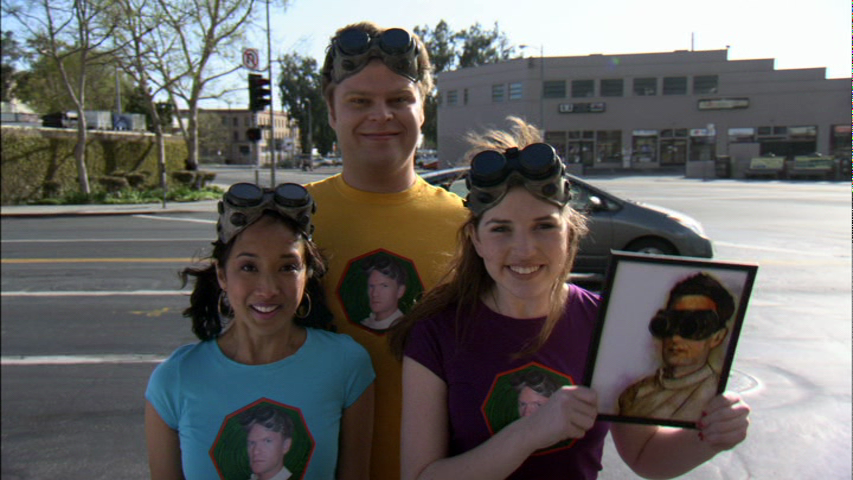
Now one perhaps might wonder what this musical has to do with erotic mad science in particular. (I mean, aside from the obvious fact that one of the principals here is Neil Patrick Harris, who by his very presence brings Teh Sexy.) To be sure there are some cute superhero groupies as well:
But perhaps the real erotic mad science connection comes in at a deeper thematic level, which is the mad science is motivated by erotic frustration. Dr. Horrible might be able to build a death ray, but his nice-guy alter ego Billy can barely bring himself to strike up a conversation with girl in the laundromat. And when he does, he finds out that she’s fallen for Captain Hammer, who isn’t just a nemesis: he’s also pretty much a complete jerk as well. The science nerd shoved out of the way by the jock.
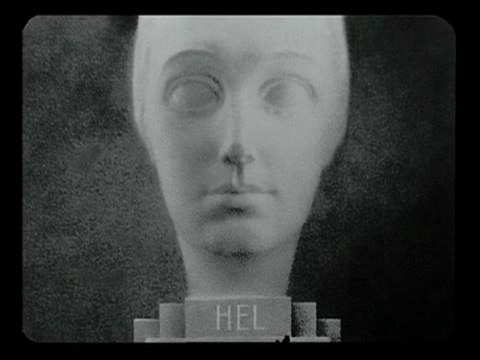
We’ve seen this before a lot. Remember:
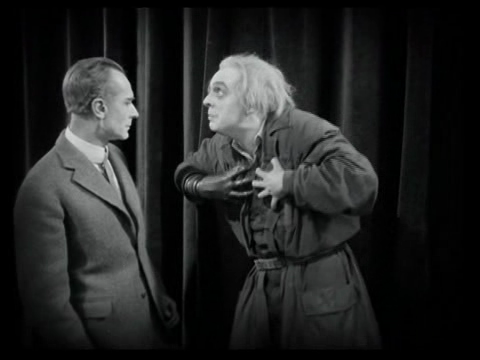
That’s from Metropolis, the ur-mad science movie. The woman represented is Hel, the love interest that Rotwang lost to wealthy industrialist Joh Frederson, a source of unending grievance for Rotwang of course.
There seem to be two cardinal mad-science motivations: Prometheanism and Woundedness. (Note that they are not exclusive: they might both be present in a single character.) The Promethean I’ll discuss in later posts. The Wounded is someone turned to mad science because of some terrible frustration or failure or lack. That lack need not necessarily have anything to do with erotic frustration or romantic failure. But it seems to turn out that way surprisingly often. And Dr. Horrible like Rotwang is a prime example thereof.
In a way Woundedness is the flip side of much of what Erotic Mad Science is about: instead mad science leading to erotic gratification, it’s about erotic frustration leading to mad science. Mad science is the revenge of the nerd or vis compensation. One either uses it to get power that gets the girls (in song Dr. Horrible fantasizes about winning his dream girl’s heart by presenting her with “the keys to a shiny new Australia”) or one simply end-runs the tedious romantic process entirely: hence all those tube girls and created women and sexy robots. Why venture into the minefield of humiliation that is human courtship when you can bypass it with your shiny jetpack or matter transporter ray?
There’s another Erotic Mad Science theme here, but it involves a spoiler, so I’ll run it beneath the fold.
Sometimes you get lucky and find a movie that’s not all that well regarded critically but which hits all sorts of notes for you, and a recent discovery, The Four-Sided Triangle(1953), was that for me. An early release of Britain’s mighty Hammer Film Productions, it sure does a lot for the thaumatophile, it’s a personal identity porn forerunner to Hammer’s Frankenstein Created Woman. And it pleases me all the more because my learning of it came from a different post at Erotic Mad Science, one presenting my then-latest search after tube girls.
Plot background: In the sleepy English village of Hardeen impoverished boy genius Bill, the son of the local squire Robin and blond beauty Lena grow up together as best friends. Bill comes under the tutelage of the kindly but slightly dim Dr. Harvey. Lena is in time taken “back to America” by her mother (a good writing cover for the fact that adult Lena will be played by American actress Barbara Payton and won’t really have the accent), while Bill and Robin go off to Cambridge to learn science. Bill and Robin will return to Hardeen and set up shop in an old barn, working on a mysterious mad-sciency project funded by Robin’s father Sir Walter.
Lena returns to Hardeen a little later, a broken woman very young: she’s tried many things and failed and returned essentially to die, as she tells a shocked Dr. Harvey in a line whose nihilistic spirit might have come from Iris Brockman.
Lena
I thought doctors were supposed to understand how little life really matters. There are many scapegoats for our sins and failures, and the most popular is Providence. I shan’t blame anyone but myself. I didn’t ask to be born, so I have the right to die.
(This is perhaps a little scary in hindsight for a reason in addition to the obvious one, given that Barbara Payton was at this point in her career in a downward alcoholic spiral that would lead to her own death at 39.)
Well, Dr. Harvey is having none of that, so he re-introduces Lena to her two childhood friends. Things go well, as Lena rejoins them as an assistant.
It turns out that Bill and Robin are working on a technology that allows them to reduplicate material objects with perfect fidelity. After much effort they succeed. Unfortunately, things don’t go so well on a personal front. Love walks right in and wrecks destruction, as love has a way of doing. Bill and Robin both fall in love with Lena. Repressed-but-sensitive genius Bill dithers over expressing his feelings, while self-confident upper-class Robin has no such hesitation. Robin proposes marriage to Lena, who accepts happily, leaving Bill devastated.
Soon Dr. Harvey finds Bill back in the laboratory, this time using his reproducing technology to recreate not just inanimate objects but living animals and…can we see where this is going, fellow thaumatophiles? Yes we can. Bill is planning to make a duplicate Lena for himself.
And here is where The Four-Sided Triangle takes a more interesting turn. Instead of following a more traditional mad-science script in which Bill would kidnap Lena and have his way with her, Bill instead explains what he wants to Lena, and tender-hearted Lena agrees to take part. Not that I want to dis the traditional plot, which certainly has its appeal, but at least this time I like the way this one was written so much better. Do you remember, dear readers, my post on The Invisible Woman?
Let’s reflect on what Kitty has implicitly gone for here: “So, you want me to take off all my clothes, step into this machine that has hitherto never been tested on a human being, zap me with heaven-knows-what, and turn me invisibile? Sure, I’m game!”
I think I’m in love.
Well, I think I’m in love all over again (perhaps I’m about to get destroyed, who knows?).
So Lena climbs into the apparatus. Switches are thrown, lights flash, and so on. Do you see the eccentric arrangement of the glowing tube in the background? The people who made this film knew their mad science cinema. They’re paying tribute to German Expressionism here, to Metropolis and The Cabinet of Dr. Caligari, or my name ain’t Faustus.
And of course, there’s the tube girl thing going on here as well. Although contrary to tube girl tradition, and for that matter the “girl in the machine” precedent set by Kitty Carroll herself, she leaves all her clothes on.
Now why is that? Doesn’t wearing clothes somehow make the whole duplication process a little more complicated? This is dangerous stuff, people, and we need to do things right!
Oh wait, there’s that placard that I now remember from the beginning of the movie:
Okay, I get it now.
So anyway, the duplication process works once the duplicate is revived and Bill finally gets the love of his life.
Bill names the duplicate “Helen,” and they set off for a happy holiday together.
Only things don’t work out that well, because Helen is psychologically identical with Lena, and that means she still loves Robin. Uh oh. After a suicide attempt, everyone agrees to a radical measure — electroshock therapy to try to wipe Helen’s memory and give her a clean start. Significantly, Helen herself agrees to this. This is one amazing mad-science woman.
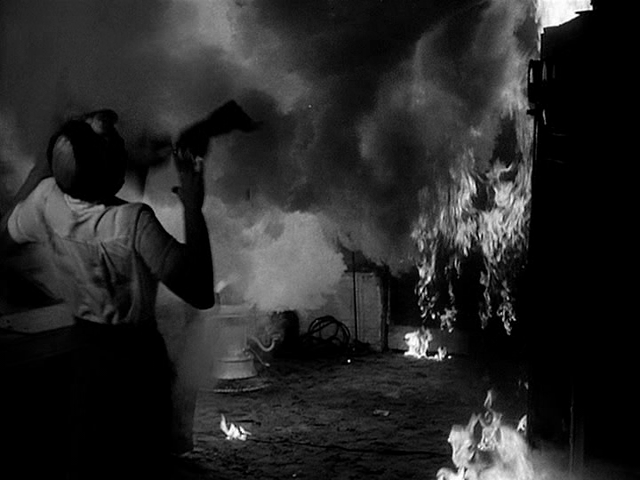
And maybe things work, but at this point the movie chickens out and runs away from its premise. An electrical short happens, the lab burns down, and Bill and either Helen or Lena are lost to us.
That’s unsatisfying, but the movie still has a lot going for it, because it’s the cinematic playing-out of the old dream, brought to me originally through the study of philosophy, and discussed in my Thaumatophile Manifesto:
And he was also sometimes thinking about “…start with some pretty object of desire, gin up a few cloning-and-growth tanks, some superduper neurosurgery, and then maybe there will be…two objects of desire, at least one of whom might be free from certain social obligations, and..” Needless to say, the Inner Mad Scientist was chortling with delight at the prospect.
Some themes are just destined to be encountered, over and over.
Bonus animated gif from Bill and Helen’s “vacation” below the fold.
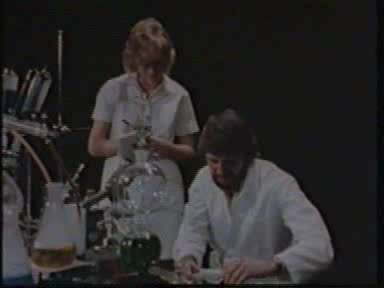
The electrifyingVinnie Tesla recently sent me a link to a snippet of German-language movie that might not be the Citizen Kane of hardcore, but which does have a nice bit of mad science in it. Entitled “New Spanish Fly,” it has a scientist at work amidst the classic thicket of chemical glassware. His assistant takes notes:
I can’t follow it too well. I’d like to blame the sound on the clip but, more realistically, my German just isn’t all that good. One bit of dialog that came across as rather funny:
Scientist
Fantastisch.
Assistant
Ah, ja?
Scientist
Notieren sie: Ich bin geil.
“Fantastic!” “Oh, yes?” “Note this down: I am horny.”
Because taking notes is an important part of SCIENCE!
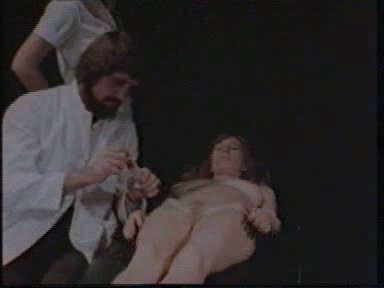
Of course, another part of SCIENCE is actual experimentation, and they proceed to this right away. Safety protocols? Animal testing? Ha!
Where this leads to you may use your imaginations to figure out. Or you can watch the clip, linked to above. You can see some really nice tubes.
By the way, what is the Citizen Kane of hardcore? I’m afraid I don’t know…
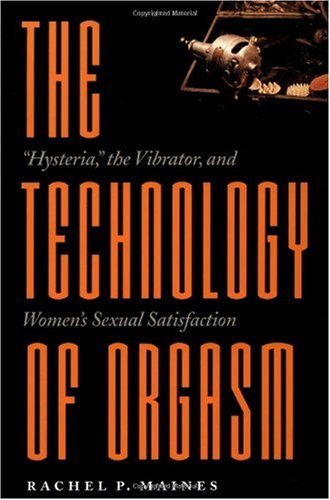
Many readers of this blog, I hope, will be familiar with a certain work by historian of technology Rachel P. Maines called The Technology of Orgasm: “Hysteria,” the Vibrator, and Women’s Sexual Satisfaction. If you’re not familiar with it, you might owe it to yourself to head down to your local library and check it out. Short summary: in 1970s, when Dr. Maines was reading turn-of-the-century women’s magazines in the course of researching a rather different topic in social history, she kept coming across advertisements for what were clearly (gasp!) electric vibrators. What was going on here? Well, it turns out that physicians for a long time had a lucrative practice in performing massages of women’s genitals for the treatment of “hysteria,” which in reality meant that they were manually stimulating women to orgasms that they presumably weren’t getting by other means in their repressive Victorian and Edwardian environments. (Cf. Honoré de Balzac: “The majority of husbands remind me of an orangutan trying to play the violin.”) It had to be physicians, because of course no one could just come out and admit that women were paying for sexual pleasure. No indeed: must honor those puritanical sexual norms by providing what Dr. Maines calls “social camouflage,” here by pretending that women’s lack of orgasms was a medical condition requiring treatment by a doctor. The only catch was that doctor’s didn’t actually like performing this service all that much, and so once someone finally invented a small electric motor, it was technology to the rescue in the form of the vibrator!
All an excellent read: I commend it to your attention. It’s a real science analog of something we’re really into here at Erotic Mad Science.
So it was a great pleasure for me when I stumbled across a bit of video of Dr. Maines recently discussing recent advances in sex technology, like Real Dolls and newfangled sex toys. (Link here in case the embedding doesn’t work for you.)
What struck me most of all his just how funny much of this came across as being. Especially the bit in which Dr. Maines comments about how “you’ve got something hot and something wet and…electronics and those are not a good combination.”
A browse through my library the other day brought to mind a possible inspiration for the hyperspatial cinctures that play such an important technological role in the parascreenplay Where Am I? If you’re not up to speed here, the hyperspatial cinctures were devices that allowed someone to section off a part of ver body without harm — blood, nerve sensations, etc. would continue to flow across some sort of hyperspace, so you could put your limbs in one place and your trunk in another. Quite the mad science bondage toy. Potentially quite dangerous, as Dolly Gibson would find out.
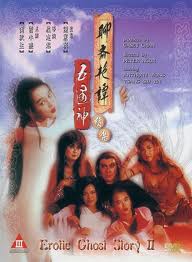
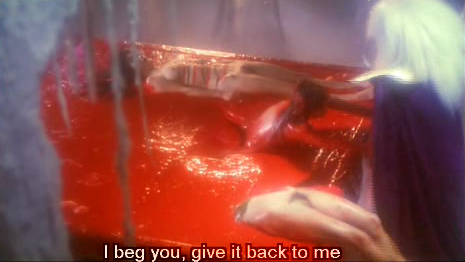
Well, it turns out that these mad science devices have a magical antecedent in cinema, from the wild Hong Kong movie Erotic Ghost Story 2 (1991). (*) Want to take a guess as to what’s going on in the scene below?
Yes, you got it right. An evil demon has kidnapped a pretty peasant girl and cloven her magically in half, copulating with her lower half, while her upper half complains of lack of satisfaction.
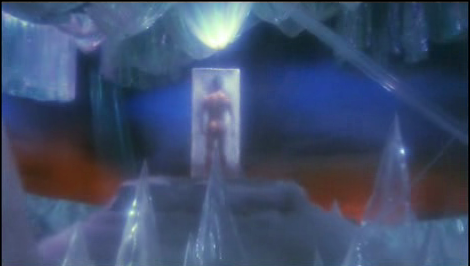
This movie has a hell of a lot going on in it. Sure, it’s not great by any reasonable cinematic standard, but it does have lots of energetic softcore sex, copious male and female nudity, demon sex, underwater sex, very creative use of a swing, and even an A.S.F.R.-like scene in which one of our heroes is frozen naked in a giant block of ice.
He gets better, though.
Why oh why don’t we have movies like this in English-language cinema? Lots of unapologetic sex integrated with goofy-fun mad science/magical effects inside an actual story in which we do care, at least some, what happens to the characters? Granted there are a few, like Invasion of the Bee Girls. But where is our Robotrix? We need more of these, dammit!
I guess that’s a large part of the reason I ended up writing parascreenplays. More ordinary people can have movies that enact sexual fantasies, but thaumatophiles like me have to fantasize even the movies…
(*) Chinese-language title 聊斋艳谭2, which in pinyin I believe would read liáo zhāi yàn tán èr. Unfortunately my feeble attempt to excavate a literal translation generates gibberish: “chat fast beautiful Tan two,” so not only do I get too few movies, I suck at Chinese also. Darn.