Pleasure and essences

I decided to take a little break from fictional mad scientsts recently and devote some energies to reading something by a real sane scientist, in this case Yale psychologist Paul Bloom, who has a splendid new book out called How Pleasure Works:  The New Science of Why We Like What We Like.

Now How Pleasure Works is a remarkably rich book in spite of its short length and it is difficult to do much justice to it in something like a blog post, but one major take-away therefrom is a lot of evidence for the thesis that the pleasure we take about things depends critically on our beliefs about their natures and histories, and not just their sensory properties.

Let’s bring that down a few levels:  Bloom is defending at least three theses here:

  1. People are innate essentialists.  They think that things are what they are not just be virtue of their perceptible properties, but that they have some sort of deeper structure or inner nature that makes them what they are.  A robot that simulates the behavior and appearance of a tiger is not a “real” tiger, even if it can fool an experienced observer.  Your spouse’s monozygotic twin is not your spouse, even if ve is so identical that ve can fool you.
  2. The history of how things is (usually) a part of their essences.
  3. Our beliefs about the essences of things affect the pleasure we take in them, over and above just how they strike our senses.

That’s still abstract, so perhaps some illustrative examples will help:

  1. People will take a lot of pleasure in a painting that they think was done by Vermeer, but if the painting is subsequently shown to be a forgery, they will take a lot less pleasure in it (and its value will drop precipitously), even though it’s the same painting as before and presents the exact same image to the retinas as before.
  2. Children who have comfort objects (teddy bears or dolls or special blankets, as examples) really do not want substitutes for these items, even if the substitutes are identical.
  3. You might be turned on a lot by an attractive model in an erotic photography shoot, but if you were to suddenly that she was your mother at age nineteen, your attitude might change.

I guess I read Professor Bloom’s book with unusual fascination, because if his understanding of pleasure is correct, it becomes easier for me to make sense of some of the stuff that spills from my fingers onto the page.  Bizarre claim?  Well, consider the notion that something has an essence that remains even if its perceptible qualities change.  It’s a curious piece of common sense, only in light of which can a weird declaration like the following even make narrative sense:


Corwin holds the phial up. Its contents are pale green and appears to glow slightly.

CORWIN

And there we have her.

NANETTA

(looking fearful and disbelieving)

Her?

CORWIN

Anwei!

NANETTA

Anwei?

CORWIN

Yes, Anwei. The beautiful young Anwei, as liquid essence. Liquid girl! Feel..

Corwin tries to press the phial into Nanetta’s hand.

corwin

…she is still warm.

The conceit here relies on an essentialist notion. The appearance of what’s in the phial is a warm pale-green liquor, but its essence is that of a pretty young woman. (Hard to read this over without thinking that perhaps it’s a satire of the doctrine of transubstantiation, and perhaps that’s what it really is.)  Without a certain kind of essentialist intuition, you wouldn’t even be able to make sense of the action here, which I am sure you can, even if you think it’s very weird.

Indeed, pretty much any kind of transformation fantasy relies on a certain kind of essentialist notion in order to be readily accessible.  At the moment in Progress in Research when Willie and Professor Waite engage in their Freaky Friday Flip, we can still locate a character who is “really Willie” and another who is “really Waite” and make sense of characters who appear to be other that what they are on that basis.

Professor Bloom also spends rather a lot of time discussing cannibalism, of all things, drawing on the notion that somehow essences might be transmissible across objects (one anthropological explanation of cannibalism is that cannibals are trying to absorb properties of the people they are eating). He even discusses the notorious Armin Meiwes voluntary cannibalism case (don’t read if you squick easily).  Fascinating, because I ran into that before.  There’s an exchange between Jill and Iris in Study Abroad about Iris’s experience of being cannibalized but (maybe) surviving due to being re-created:


JILL

Why not just make a backup, and eat it?

IRIS

I did think to ask. I was told that the clientele thought that experienced meat tastes better.

BRIDGET

Ew.


Apparently the diners in Club Cuisine preferred eating a real American college student with a real life history to merely a simulacrum of one. Like I said, don’t read if you squick easily…

The notion of essences transmitted over history might also be of help in understanding phenomena like agalmatophilia.  When Iris queries Mr. Takayama about why anyone would go the trouble to petrfy another person, he responds in terms that Iris can immediately understand.


TAKAYAMA

There will always be a deep appeal to whatever it was that was once alive. In luxury goods markets, real leather, real silk, real fur will always command a premium over their synthetic substitutes, precisely because of the seductive fact that they were all part of something once alive. Add to that the natural erotic appeal of a well-formed sculpture, and you can see commercial viability.

IRIS

Yes. I see. That was certainly the appeal I sensed behind the Club Cuisine.

A statute that was once a beautiful woman is a very different sort of thing from merely a statue of a beautiful woman, and (for at least some people) something that carries a vastly greater erotic charge.

Indeed, Paul Bloom’s analytical framework might even give a way of explaining what thaumatophilia is.  It’s someone who gets a real kick out of pushing the boundaries on essentialism, either by imagining scenarios where appearance diverges wildly from essence (human subjects become liquid, or statues, or giant spider goddesses), or we push beyond our essentialist intuitions altogether:  people are happy to be replaced with copies of themselves just to prove a philosophical point, or rejoice in being the fusion of two previously existing people.

A reflection that occured to me after reading Bloom’s book is that a thaumatophile is someone not content merely to be a sexual deviant.  Ve wants to be an ontological deviant as well.

While I heartily encourage anyone interested in the subject of this post to buy How Pleasure Works, you can get good stuff for free on the subject by watching Professor Bloom’s recent Bloggingheads diavlog with Robert Wright. And I also heartily recommend this excerpt in the Chronicle of Higher Education on the pleasures of the imagination, something this site itself is all about and which is not merely and instructive discussion of pleasure, but a fine source of it.
Mad Science non-essential: Mesa of the Lost Women

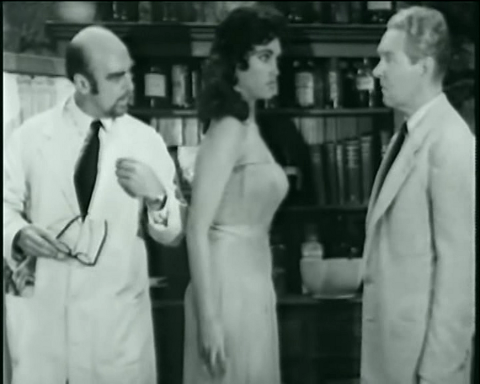
Having enjoyed myself writing a tale of a woman who turns into a giant arachnid, I thought it fitting to watch a movie about arachnids turned into women.  Is there such?  Of course there is!  Probably there are many, but one of the most readily accessible is a 1953 oddity called Mesa of the Lost Women.

Told largely in flashback, the core story of on Leland J. Masterson, World Famous Specialist (in what exactly it isn’t clear) who answers a summons of the mysterious but brilliant Dr. Aranya, who’s running a laboratory inside a mesa in a Mexican desert.

A mad-lab, it turns out.  Dr. Aranya has figured out a way to transform tarantulas into beautiful women.  There are a few seconds of half-way decent mad-lab footage.

Dr. Aranya is the gentleman on the left in the white lab-coat.  Do you recognize the actor?  Neither did I.  But a little digging turned up that he was someone genuinely Hollywood famous:

Yes, Jackie Coogan.  “The Kid” in Charlie Chaplin‘s The Kid.  He would go on to play Uncle Fester in the 1960s Addams Family television series.   Possibly he did not look back on this movie as the high point of his career.

Masterson, upstanding Pillar of the Establishment he is, throws an absolute fit when he finds out what Aranya is up to.  I really don’t understand what Aranya’s problem is:  it looks like Aranya’s work is succeding brilliantly.  His creations are intelligent enough to help him with his scientific research, can communicate telepathically, can regenerate lost limbs (although we don’t see them do this), and recover in minutes from what would be fatal bullet wounds (we do se this).

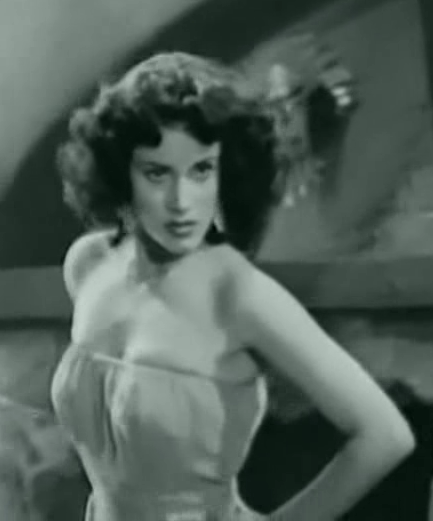
Oh, and did I mention that some of the female ones are smokin’ hot?  The most successful in this regard is “Tarantella,” played by Tandra Quinn.  She treats us to a dance in  a cantina, which doesn’t really do much to advance the thin plot, but which at least provides a few more minutes of watchable footage.

Since Masterson (played by Harmon Stevens) refuses to help Aranya, Tarantella gives Masterson an injection which turns Materson (temporarily) into an idiot.  In this condition, he looks eerily like a prototype for Peter Sellers‘s role of Chance the Gardener in Being There (1979).

I mean, maybe it’s just the power of hats, but the resemblance is uncanny.   There are even moments in which the speech mannerisms in Stevens’s performance seem to prefigure those in Sellers’s.

This movie clocks in at 67 minutes and feels overlong.  Such an interesting premise, so little done with it.  Most of the movie has to do with a bunch of very unlikeable characters trying to survive attacks from Dr. Aranya’s creatures.  A useless and intrusive narrator appears at the beginning and the end of the movie to warn us that mankind is outclassed by the insects (tarantulas are arachnids, not insects) and “the hexapods” (tarantulas have eight legs, not six).  It features one of the most headache-inducing musical scores to hit my eardrums ever.

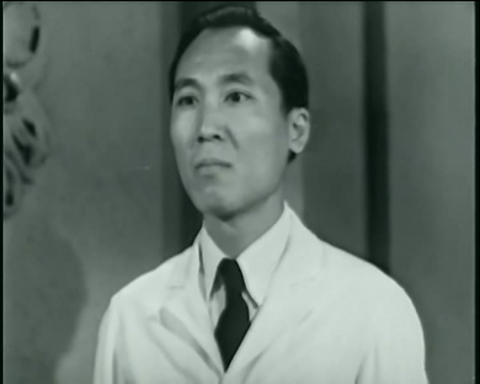
Oh, and even if you can pardon the patronizing way this movie treats Mexican people, we get Wu, an Asian valet right out of Stereotype Central:  fatalistic, servile, and prone to communicate primarily in cornball pseudo-Confucian aphorisms.

There are things that I do genuinely miss about old movies, but characters like Wu are not one of them.

Still, I should think this is worth mining for a few minutes of footage for the mad science completist.  It’s public domain and available at the Internet Archive.

Link here in case the embedding doesn’t work.

Aesthetics of not-the-Fly

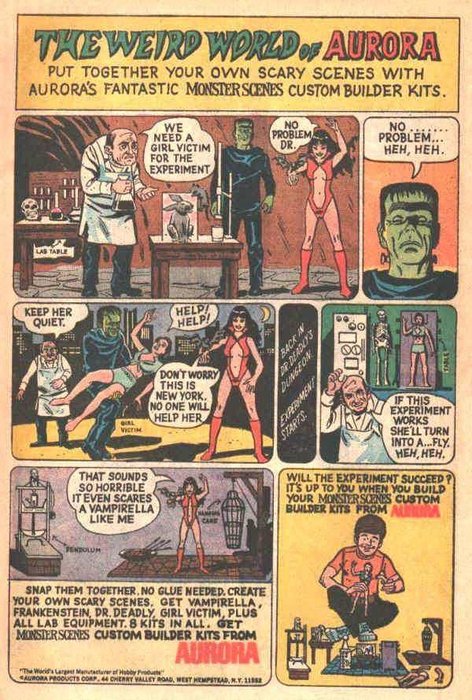
The thought of people turning into flies means that now I just have to post this disturbing comix advertisement, to which my attention was directed by Bacchus and which appears on the tumblr blog Comically Vintage.

“She’ll turn into a fly, heh heh.”  Well, that’s at least thematically apropos this week.  My initial reaction to the ad was a lighthearted “it’s Poser for the pre-computer era!”  But there are naturally some darker strains here.

There’s a wealth of weird in this ad, beginning with the strange cast of characters:  Vampirella, Frankenstein’s Monster (misidentified as “Frankenstein” in the ad) and an obscure mad scientist called “Dr. Deadly.”  (Guess his experiments don’t work so well.) I wonder how disturbed we should be that there’s a specific action figure designated as “Girl Victim,” or that these are apparently action figures meant as children’s toys.

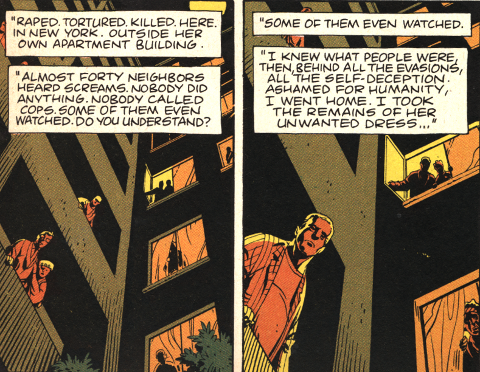
The line “Don’t Worry, this is New York, no one will help her” marks a special (and, to my mind, ugly) cultural moment, perhaps an indication of the long shadow cast by the 1964 Kitty Genovese incident, which of course has its own deep comics resonance — awful real life intersecting with popular culture.

In a children’s toy, a reflection of the “New York = hell” meme that would be so common in the popular culture of the 1970s. (One manifestation of which would be the 1974 movie Death Wish, which would mark — you guessed it — the first screen appearance of Jeff Goldblum, so it all comes full circle, yes?)

On a side note:  isn’t Vampirella supposed to be a heroine?  If not entirely benign, then at least certainly not the sort who would help kidnap innocent young women into horrible mad-science experiments.  Am I misssing something here?  Perhaps someone more familiar with the history of the character can set me straight in the comments.

Aesthetics of the Fly III

In the end, Seth Brundle decides he just can’t hack being a human-fly hybrid (one which is becoming more fly than human as time goes on).  And there have been complications, in the form of his girlfriend Veronica getting pregnant (with what it’s not clear).

So Brundle comes up with  what is clearly very much a mad science idea, which is that he is going to use his transporter to fuse himself, Veronica, and baby into a single hybrid, one which he hopes will be more human than fly.

It’s quite an audacious idea, I must say, and perhaps it’s one source of my idea of fusing Maureen Creel and Jill Keeney into a single woman named Jireen.  Unfortunately for science, Veronica is no more keen on the idea of being fused with Brundle than Aloysius was with Jireen, when Jireen proposed exactly that.

It’s a close call for Veronica, though.  She almost gets fused.  And I must say she makes a fetching mad science almost-victim.

Not a movie that really ends well for any of its protagonists.  But it’s a true classic all the same.

Aesthetics of the Fly II

Seth Brundle might not start out mad.  As a scientist he doesn’t want to create new life out of dead tissue or take over the world or shake his fist angrily at God.  He just wants to create a technology that I’m quite certain would benefit humankind if it could be made to work:  a matter transporter.  (And if you don’t think it would benefit humankind, there’s a twenty-hour nonstop flight from Newark to Singapore that I invite you to take sometime.)

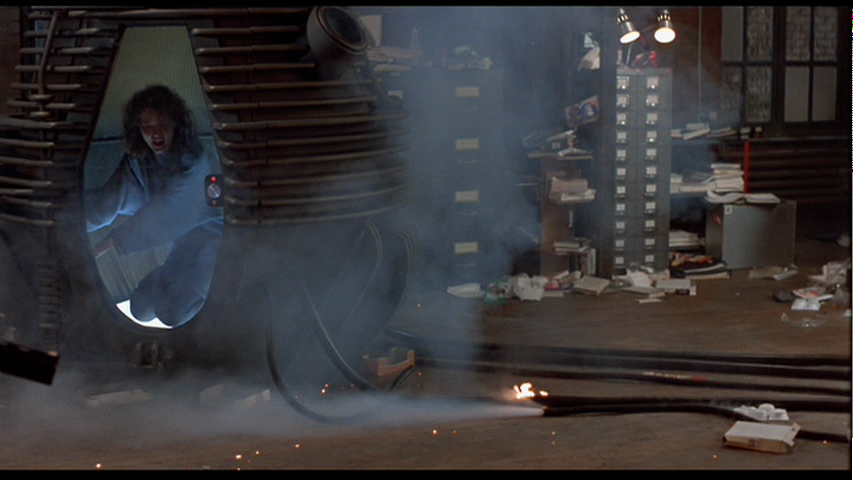
Now as we all know, matter transporters have a way of not working quite right when people go through them.   In poor Seth Brundle’s case, a fly gets into the tranporter pod with him and…well, a certain fusion takes place.  Brundle wasn’t careful enough.  But even his recklessness isn’t really mad scientist hubris.  It’s very human scale:  he gets drunk because he (wrongly) suspects that his marvellous new girlfriend Veronica Quaife (played by Geena Davis) is being unfaithful to him.  One thing leads to another, he hops in the pod and that sets in motion some bad things.  Like his slow transformation into…Brundlefly.

Dear reader, judge Brundle not harshly.  How well would you behave if your marvellous new girlfriend played by Geena Davis appeared to be mistreating you?

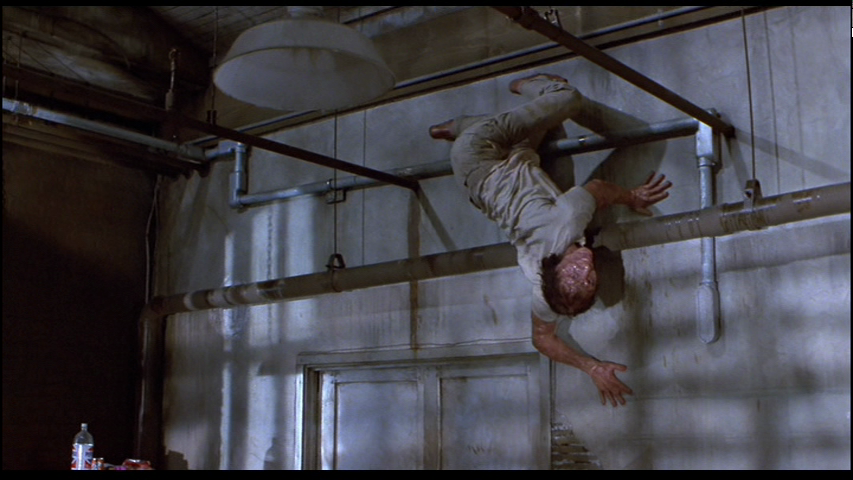
The impressive thing here is that after he begins transforming (manifested, among other things, by his ability illustrated above to climb walls) is that Brundle does become a good deal more mad-science.  Consider this soliloquy to Veronica:

I seem to be sticken by a disease with a purpose wouldn’t you say?…Maybe not such a bad disease after all…I know what the disease wants.  It wants to turn me into something else.  That’s not too terrible is it?  Most people would give anything to be turned into something else.

I rather like that — perhaps it influenced the sort of speech that Cleo Mount gives on the day of her final transformation on the merits of embracing what you have become, even if it seems monstrous to others.

Alas, since this is a David Cronenberg movie, this is not a cheerful attitude that Brundle will be able to sustain, as I shall discuss in an upcoming post.

Aesthetics of The Fly I

I’ve recently been rewatching David Cronenberg‘s 1986 version of The Fly and have been reminded of its influence in my consciousness — something worth a series of posts, I think.

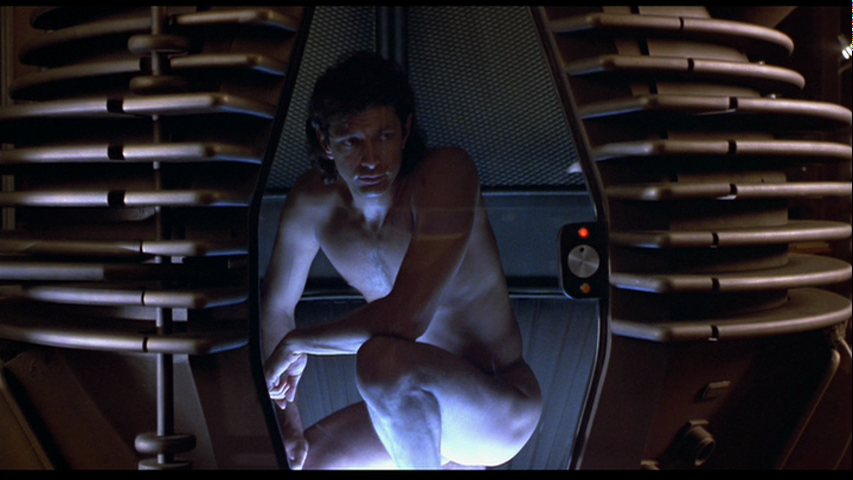
The doomed scientist-protagonist of The Fly Seth Brundle (played in this version by Jeff Goldblum) doesn’t actually start out as what I would call a mad scientist.  Eccentric, certainly, and perhaps a bit socially inept.  But he’s clearly brilliant, and working within the system, mostly.

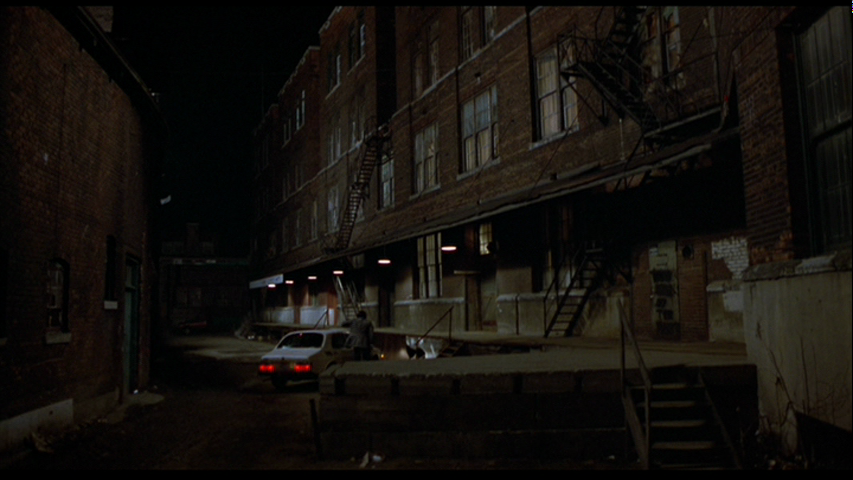
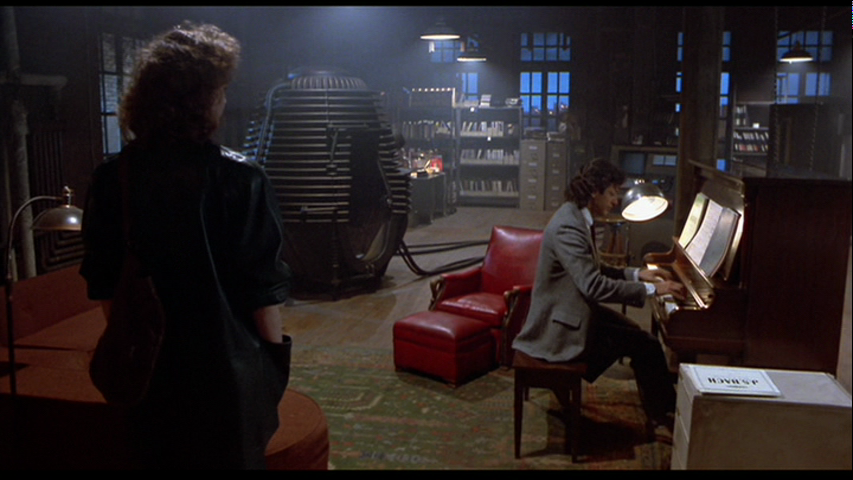
But the trappings are in place even before things get weird.  I love the space that Brundle has chosen for a combined laboratory/living space.  An exterior view:

A repurposed factory or warehouse.  Probably very influential on my consciousness.  I grew up in an old industrial town and there were a lot of these around.  I’m sure to most people they just seemed like eyesores, but to me even very young they had a poetry about themselves, seeming to places of mystery or concealment of secrets.  I was well primed to receive images of this space.

The interior, with its odd mix of research and living space, does not disappoint.

Between this and what I saw in childhood, you have the seeds for the settings of Corwin’s off-site laboratory in The Apsinthion Protocol, the improvised hideout of Commencement, and the shocking mad-lab of “Teuthology.”  (The last bit coming soon…)

If I ever win the lottery (which is unlikely, since Dr. Fautus knows enough about expected value theory not to play the lottery, but kindly bear with the cliché here) I am so getting myself a place like this.

Of course, the aesthetics can only be improved by the presence in the setting of Jeff Goldblum.

Not clear that you can in any lottery where you can set yourself up with this.  If only Dr. Strangeways’s human duplication equipment hadn’t gotten itself imploded

Mad scientist humorist!

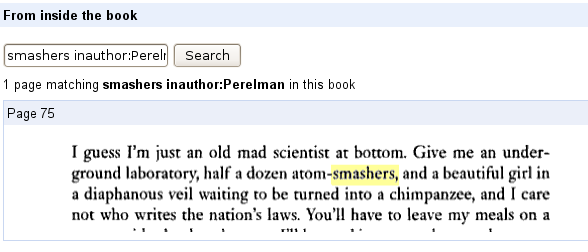
After having a look at Hugo Araújo’s artwork,  a wise old friend provided an amazing quote from the great American humorist S.J. Perelman:

Give me an underground laboratory, half a dozen atom-smashers, and a beautiful girl in a diaphanous veil waiting to be turned into a chimpanzee, and I care not who writes the nation’s laws.

And I thought, “Damn, this is just too good to be true.  My friend must have just made it up.”

I mean, ve‘s good enough to pull something like that off, if he has a will to.

But what you know?  The citation is genuine.

Amazing!  One of the greatest of all American comic writers (did I mention that he also co-wrote the book for One Touch of Venus, thus providing a link to another Faustus-favored creator?) had his own thaumatophile leanings (albeit, possibly only in jest).

Reality often disappoints, but sometimes it really satisfies.

Willy Wonka Mad Scientist VII

One last post on Willy Wonka before moving on to other topics.

In the 2005 adaptation, Mike Teavee presents an interesting sort of character in that it is suggested that even if a horrid child, he is something of a mad genius.  He finds the golden ticket that gets him into Wonka’s factory not through dumb luck (like Augustus Gloop and Violet Beauregard) or a brute force approach (like Veruca Salt) or the operations of karma (Charlie Bucket, of course) but through a calculation — something involving shipping dates, controlling for the weather, and “the derivative of the Nikkei.”

And confronted with Willy Wonka’s transportation technology, he takes a perfect mad scientist attitude.

int. willy wonka’s television room – day

mike

Don’t you realize what you’ve invented? It’s a teleporter! It’s the most important invention in the history of the world. And all you think about is chocolate.

mr. teavee

Calm down, Mike. I think Mr. Wonka knows what he’s talking about.

mike

No he doesn’t. He has no idea! He think’s he’s a genius but he’s an idiot. But I’m not…

Mike makes a dash across the room toward the teleporter device, knocking down two Oompa-Loompas as he does so.

wonka

Hey little boy…don’t push my button.

But push the button Mike does, with himself as experimental guinea pig.  An ideal “I’ll show them” attitude that wouldn’t be out of place in more movies than I could probably name.

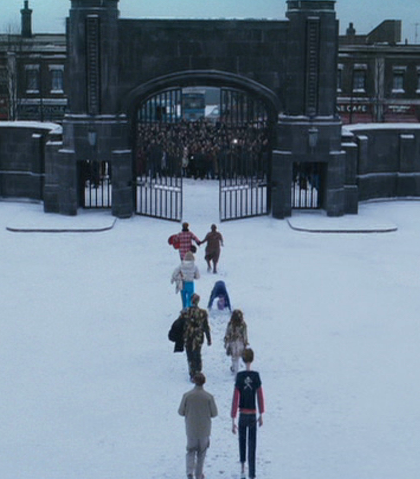
Now Mike does sort of get out of his predicament, albeit rather changed.  Wonka’s remedy for Mike shinkage is to stretch him out like taffy.  This leaves Mike rather tall and thin, as the shot of the departing horrid children clearly shows.

Mike, unlike Violet, gives no indication of being at all pleased by his transformation.

I don’t think I’m giving away a spoiler in indicating that in the end Charlie ends up as Wonka’s heir as a mad science confectioner.  But what of Mike?  Might he not be vowing revenge?

I think that there could be a great sequel here, where a grown-up (but still physically warped) Mike Teavee becomes a supervillain mad scientist, seeking to wreck revenge on the grown-up Charlie Bucket.

Willie Wonka Mad Scientist VI

Mike Teavee’s fate at the other end of his teletransporter adventure is to be re-assembled — but not quite at the right scale.  In the 1971 adaptation this means a not-too-convincing front projection effect to show Mike to scale with his profoundly dismayed mother.

Special effects technology had improved a lot by the time of the 2005 adaptation, but Mike still ends up tiny.

The concept of someone shrunk to really tiny through either magic or mad science is at least as old as Alice’s Adventures in Wonderland (and probably much older). but the 1971 adaptation is the first cinematic version of the idea I can recall seeing, and probably the first that many other people can recall seeing as well.

And unsurprisingly, it’s fetish fuel for some.   For one thing, if you shrink only the person but not the clothes, it’s a way to get someone naked in a hurry.  (It’s the flip side, of course, of making someone expand dramatically without the clothes adapting.)  I’ll admit, I’ve gone there before, and I’ll go there again with a slight re-write, if only because I want to try out a bit of new blogging technology.   I’ve been trying to figure out a means for comic book scripting in HTML that shows possible underlying panel and page geometry better than a simple linear script.  Of course that’s not something that a person of ordinary prudence and common sense would attempt, but since I’m clearly not one of those, here goes:

STACEY, a voluptuous coed, is wearing a short skirt and a v-neck shirt with the words GNOSIS COLLEGE written on it She is stepping onto the transporter pad, a circular raised dais with large cables running into it.

CAPTION: A demonstration for the skeptic!

STACEY: Professor Oddbol, are you sure this is safe?

A full-on view of PROFESSOR ODDBOL, who is wearing a full-length labcoat and a pair of heavy goggles, and standing behind some sort of elaborate control panel.

ODDBOL: Perfectly safe, my dear. I propose only to send you across the room..

Stacey is being picked up by Oddbol’s hand (the scaling shows that Stacey has shrunk down to the size of Oddbol’s index finger.

CAPTION: Looks like Oddbol will being doing some interesting experiments soon.

STACEY (balloon with tiny words): Put me down!

There is a Stacey-shaped FLASH where Stacey was standing on the platform. Stacey’s now-hollow clothes are caught in mid-action beginning to fall to the pad.

CAPTION: Transported!

SFX: SZZZT!

STACEY (partially jagged balloon): Well, okay but…EEEK!

A tiny Stacey is standing, nude, covering her private pats with her hands. Behind her, the giant face of Oddbol can be seen looming. He is scratching his head.

STACEY (balloon with tiny words): Help me!

ODDBOL: Oh dear. There seems be a problem with the matter scaler.

It’s worth noting, I suppose, that Tim Burton, whom the Gods blessed with abundant weird and who did both the 2005 Willy Wonka adaptation as well as a recent version of Alice in Wonderland does toy with the idea that shrinking and growing will get the pretty girl out of her clothes.  But of course, since it’s a PG-rated movie made within the Empire of Mouse, he only toys with the idea.

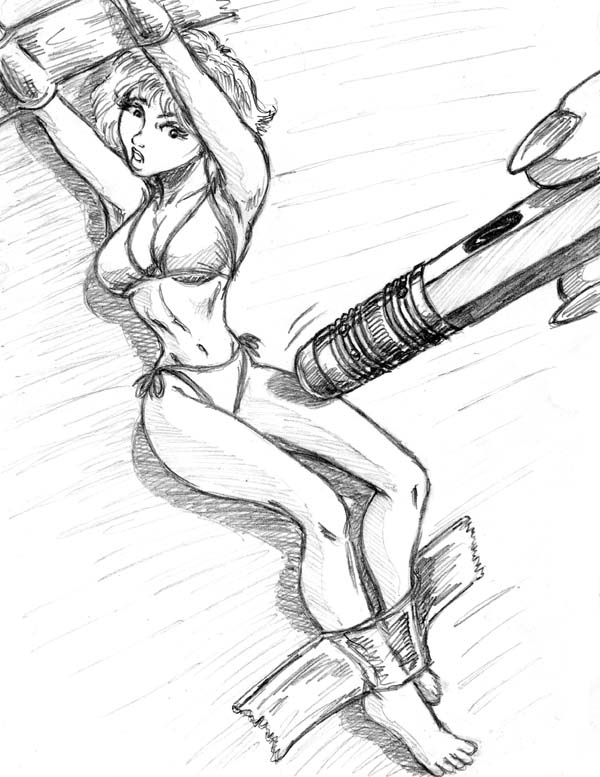
Out on the wide Internet, we might be poor in resources but we are rich in creative freedom, and people go much deeper into the kink of shrinking.  One of the finest might be the Minimizer, who really has a thing for shrinking women, and unsurprisingly often for the mad science that might lead to their creation.  Ve comes up with the most becoming of sketches.

Should you wish to extract some extra kink from the image, the (probably) mad scientist who wields the pencil which helpfully provides a sense of scale here is a woman.

The Minimizer does commissions.  And the links page shows that there are some people who are clearly way into all this.  I wonder how much of it might have started with Mike Teavee… [Faustus May 11, 2018: This information is probably no longer current as the Minimizer’s site appears to be no longer maintained. The one link in the post above is to a preserved version in the Internet Archive.]